
On this page
Buying SaaS source code gives you a software starting point. Buying an existing SaaS business means negotiating for an operation and its agreed assets, which may include the application, brand, customer relationships and operating history. Those purchases can both lead to running a SaaS, but they answer different questions.
The useful distinction is what you need to bring after the purchase. Do you already know the audience and need a product to serve it? Or are you looking for a business whose customers and operating performance you can investigate before taking over?
Start there. A source-code price and a business asking price are not two quotes for the same thing.
A finished product and an existing business are different starting points
A finished application can remove substantial implementation work. It may already contain the customer journey, roles and operational screens your idea needs. That lets you spend your attention on fit, configuration, your offer and reaching customers.
An existing business gives you something different to examine: what people have actually bought, how they use the service and what the current owner does to keep it running. That history can inform a decision. It still needs to be verified, and it does not guarantee that customers will stay after a change of ownership.
Use this comparison to make the offer explicit:
| Question | Finished SaaS with source code | Existing SaaS business |
|---|---|---|
| What is the starting point? | A delivered application and its licence | The assets and operation described in the deal |
| Where do customers come from? | Your audience, sales and distribution work | An existing customer base only if it exists and is included |
| What does the evidence need to show? | Product fit, implemented workflows and setup requirements | Product condition, operating performance and the assets that can transfer |
| What happens to the brand and domain? | You establish your own, unless explicitly included | Their inclusion and transfer need to be agreed |
| What work remains? | Configure, adapt where needed, acquire customers and operate | Complete the handover, maintain service and understand the inherited work |
| What should you never infer? | That working software comes with revenue | That reported revenue will continue without the seller |
These are questions to resolve, not universal descriptions of every listing. A business offered for sale can be pre-revenue. A source-code deal can include additional services. The exact offer controls the comparison.
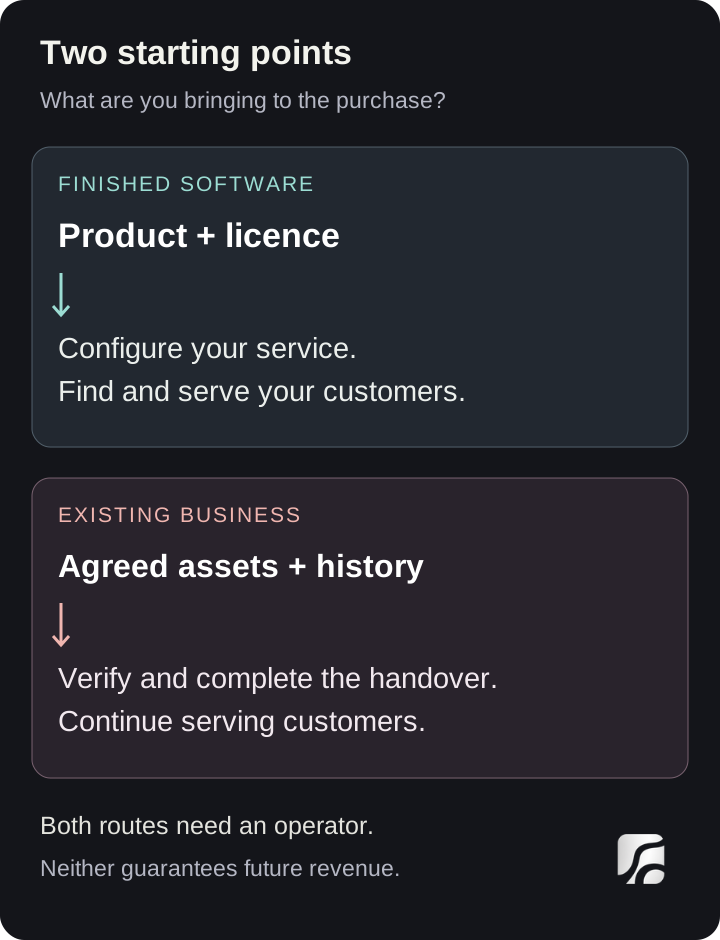
The missing work changes with the starting point. Both routes still need someone responsible for the service.
What SaaSCode provides in this comparison
SaaSCode sells finished SaaS applications as a one-time source-code purchase. You download the product and run it on your own infrastructure. The licence permits modification and operation within its terms; it does not grant exclusive ownership of SaaSCode's underlying intellectual property or permission to redistribute the source. See what the purchase includes and the licence terms.
That places SaaSCode on the product side of this comparison. Choosing an application is not an acquisition of an existing customer's business, subscriptions or revenue.
SaaSCode's AI-first factory approach describes how products are made. For a buyer, the practical question remains the application you receive: does its actual workflow fit the service you intend to offer? AI-assisted development can also help a developer make a bounded adaptation of an existing product. It does not supply demand merely because the code is easier to change.
For a closer inspection of delivery and ongoing responsibilities, read what buying SaaS source code includes. This article is about choosing between a product purchase and an operating-business purchase, rather than repeating that delivery review.
Two buyers can need the same software and make different choices
Consider two hypothetical buyers interested in appointment software. These are illustrative situations, not customer stories or listings.
The first buyer already serves a group of independent tutors. They understand the tutors' scheduling problems and can arrange product conversations. Their missing piece is an application that supports the intended workflow.
For that buyer, a finished scheduling product is worth investigating if it handles the relevant booking rules. Their next questions concern product fit: recurring appointments, cancellations, time zones, permissions and the work required to adapt the offer. They still have to turn relationships into paying demand. An existing audience is an advantage to test, not proof of sales.
The second buyer wants to take over a scheduling business serving tutors. They are interested in its customer relationships and how it currently earns revenue. A polished booking demo answers only a small part of their question.
They would want to understand why customers pay, how many remain active, which promises have been made and what the seller does each week. If users rely on the seller personally to resolve scheduling problems, the handover needs to account for that work.
The difference is not that one buyer is technical and the other is not. It is what each already has and what each is trying to obtain.
| What the buyer already brings | What deserves closer investigation |
|---|---|
| Audience knowledge and a way to reach likely customers | Whether a finished product fits that audience's actual work |
| Experience running a service and evaluating an operation | Whether an acquisition's evidence supports the proposed handover |
| A developer and a specific workflow improvement | Whether adaptation is smaller and clearer than starting again |
| Neither a defined audience nor an operating plan | The customer problem and responsibility for delivery before either purchase |
What an acquisition handover actually includes
Acquire.com is a useful concrete example of the acquisition route. Its asset-transfer guide describes a process built around identifying assets, confirming ownership and planning how they will move. It lists potential assets such as domains, intellectual property, operating documentation and customer data. Their inclusion depends on the agreement.
That is broader than handing over a repository. A repository can arrive while the buyer still lacks control of an important domain or access needed to run the service.

Original AI-generated oil interpretation of the asset categories discussed in Acquire.com's guide. This is not its interface, an actual transaction or an affiliation with SaaSCode.
Separate three questions for every important asset:
- Is it included? A mention in a conversation is not the same as a clearly described part of the agreed handover.
- Can it move? Check the relevant ownership, contractual and provider requirements for this transaction.
- Can the buyer operate it? Receiving access is different from knowing how the service uses it.
Payment accounts illustrate the last two questions. Stripe's business-sale guidance tells an existing owner to contact Stripe Support first to establish the required information changes. It also directs acquisitions involving an entity in another country to a different process. Do not treat every provider account as something that changes hands with a password.
For a particular acquisition, the agreement and provider procedures need transaction-specific review. A general article cannot decide whether a specific contract or licence transfers.
Ask for evidence that matches the purchase
The most persuasive evidence depends on what you are buying.
For a product, walk through the job you need the application to perform. Ask where configuration ends and implementation begins. Check whether the documented setup matches the infrastructure and skills available to you. The source-code evaluation guide develops those questions.
For an acquisition, extend the review beyond the product. Acquire.com's due-diligence guide covers finances, people, technology and legal questions, with evidence supporting the seller's answers. The point for a buyer is to connect a claim with the records and explanation that make it understandable.
For example, a hypothetical seller might show a monthly revenue total. Useful follow-up questions include whether it contains one-off setup work, whether a few customers account for most of it and what service those customers expect. A total alone does not explain how the business earns or keeps that revenue.
The same discipline applies to workload. “A few hours a week” becomes more useful when the seller can describe a recent week: support requests, manual imports, failed payments, release work and any contractors involved. Ask what was routine and what was unusually quiet.
These are prompts for investigation, not claims that a particular business is good or bad. No financial results, acquisition returns or seller workload were measured for this article.
Compare the next 90 days, not just the transaction
A practical way to compare two offers is to describe what you would be responsible for during the first three months. Ninety days is a planning horizon here, not a promised launch or payback period.
For a source-code purchase, that might include configuring the application, testing the customer journey, preparing the offer and learning whether likely buyers will pay. Budget both implementation and customer-facing work. Our SaaS launch-cost guide helps separate those assumptions.
For an acquisition, the first period may be dominated by continuity: completing agreed transfers, learning the operating routine, understanding open customer issues and deciding which changes should wait. A redesign that seems obvious to a new owner may interrupt something existing users depend on.
Describe a difficult week for each route. In the product route, what happens if the first prospects need a workflow the application does not support? In the acquisition route, what happens if the outgoing owner becomes unavailable before the handover questions are resolved?
Then identify who would do the work. Your own time belongs in the comparison even when it does not create an invoice.
Choose the starting point you can use
A finished product is most useful when you can explain the audience it will serve, verify the workflow and take responsibility for launching and running your version. An existing business deserves investigation when its operating history and agreed assets are central to what you want to obtain.
Neither route makes the other unnecessary. A business owner might later choose a complementary SaaS product to serve another need or support internal work. A developer might choose source code because a particular adaptation is valuable. Keep each purchase tied to its own purpose and licence.
Before comparing offers, finish this sentence: “We already have ___, and this purchase needs to give us ___.” If the second blank contains customers or operating revenue, a source-code licence alone does not answer it. If it contains a product that fits an audience you understand, buying an entire operation may be answering a larger question than you intended.
To explore the product route, browse the SaaSCode catalogue and choose one application's demo to examine against your customer journey. Start with the work you want the software to do, then decide what kind of purchase moves that work forward.
Editorial collaborations
Something useful to add?
Bring a documented case, an expert perspective or a better source to the SaaSCode blog.
Editorial collaborations