

On this page
Two SaaS products complement each other when they help the same person complete related work, or when one helps operate the business behind the other. Similar features alone do not establish that relationship.
Start with one audience and one recurring task. Ask what users do immediately before or after that task. Then inspect built products that could serve the adjacent need. This creates a reason for a recommendation, a contextual link or eventually an integration.
Distinguish four kinds of relationship
Alternatives solve much of the same problem; the user may need only one. Complementary offers solve different steps for an overlapping audience. Internal tools help the operator run the business. A combined product connects workflows through custom implementation.
Confusing these categories produces weak bundles and unnecessary development. Two applications can be useful together without sharing accounts or a database.

Inspect the details that determine the result. Editorial oil illustration.
Three pairs worth investigating
These are editorial opportunities based on the products’ public descriptions, not announcements of native integrations or bundled licenses.
| Products | Relationship to investigate | First useful experiment |
|---|---|---|
| Coursio and Vacanta | Learning and employment for a defined professional audience | Link a relevant course to a career resource and observe whether users need it |
| Formlet and Taskline | Intake and the work that follows it | Map one accepted request to a task using synthetic records |
| Listora and Venuo | Discovery and events within a community | Help a directory visitor find a relevant event before designing shared accounts |
Coursio is presented as a recorded-course platform, while Vacanta is a niche job-board product. The audience connection is our proposed use case. The two listings do not establish that learner records automatically become candidate records.
Formlet covers forms and responses, and Taskline covers project work. Formlet’s public page specifically distinguishes available functionality from workflow access that needs enablement. Inspect the current delivery and plan before designing an automated transfer.
Listora and Venuo offer another possible discovery-to-participation journey. Validate the particular directory and event workflow in their demos; a shared audience is an editorial hypothesis until you test it.
Start with an interlink the user can understand
A useful link appears where the reader has a reason to take the next step. A guide to launching a training business can point to a relevant employment resource. A help article about handling submissions can point to a workflow-management guide.
Describe the destination accurately. “Plan the work after an intake form” gives the reader more information than “learn more.” Google’s link guidance supports descriptive, contextual links that help people and search systems understand relationships.
Do not build a network of repetitive links merely to move ranking signals between sites. Each destination should add something the reader needs.
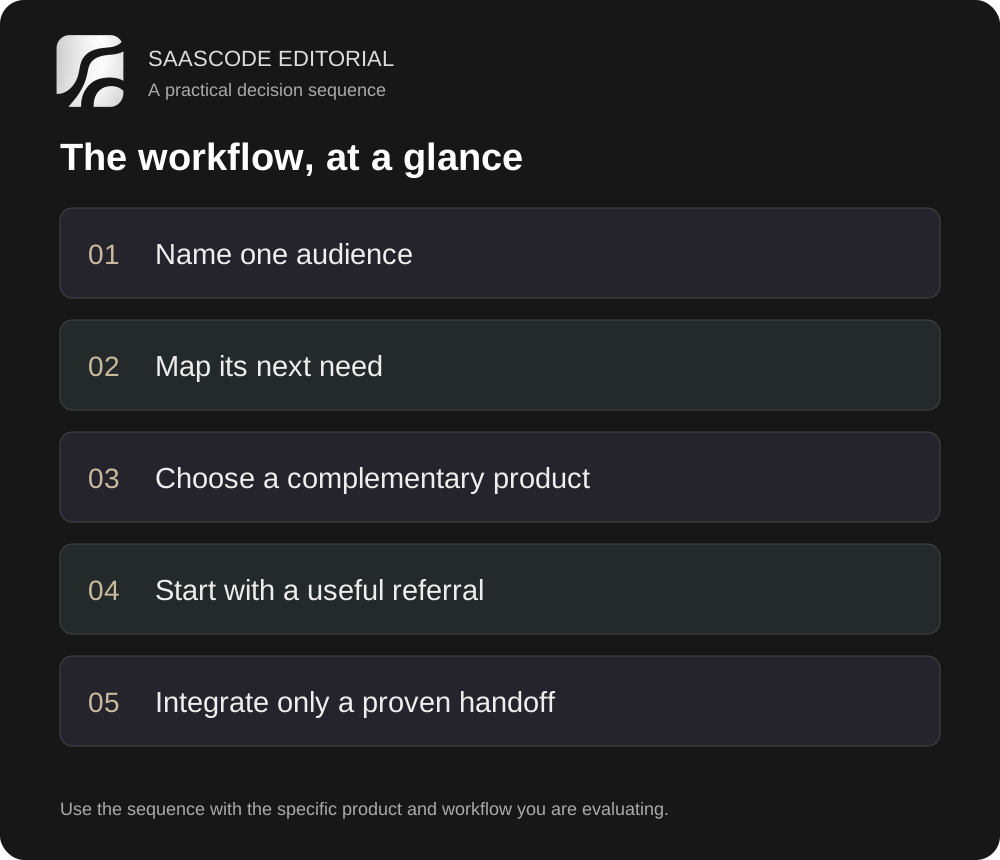
Referral, bundle or integration?
A referral is a recommendation or link. It is the lightest way to test whether an adjacent offer is useful. A bundle adds a commercial promise: what is included, who supports it and how access works. An integration adds a technical promise about how the applications behave together.
Move to the next level only when the user need justifies its cost. If customers repeatedly copy the same information from one product to another, a narrow handoff may be worth building. If they simply need to discover the second service, a clear link may solve the problem.
Our connection guide explains the additional work around data, retries and ownership.

Follow the work through to an observable outcome. Editorial oil illustration.
Evaluate the operating cost of the pair
Two products mean more than two purchase decisions. Someone must maintain their services, answer customer questions and handle failures between them. Shared branding does not automatically create shared support or shared identity.
Use the operating-cost guide to estimate incremental work. Before launching another business, apply the second-product decision guide.
Use the same principle inside your own company
An internal workflow can be a useful first experiment because the team can observe its friction directly. Keep the scope small and report what was actually used. Our guide to using your own products includes a local editorial experiment and distinguishes it from production adoption.
The best product relationship is one you can explain in a sentence about the user’s work. Build the link, offer or integration around that sentence.
Editorial collaborations
Something useful to add?
Bring a documented case, an expert perspective or a better source to the SaaSCode blog.
Editorial collaborations