

On this page
Using your own software can reveal problems that a polished demonstration misses. A team that depends on a workflow notices repeated data entry, unclear states and recovery steps that interrupt the day. This practice is often called dogfooding.
The benefit comes from real use and careful observation. Installing several products or announcing that they belong to one ecosystem does not establish that they improve the business.
Pick a task that already happens
Choose a recurring operation with a recognizable owner and outcome. For an editorial team, that might be reviewing incoming article ideas and turning accepted ideas into work. The owner needs to know what was accepted, where the task lives and whether a retry created a duplicate.
This is a narrower and more useful starting point than “automate marketing.” You can compare the previous handoff with the experiment and decide whether the change reduces confusion.
The public Formlet listing and Taskline listing make intake and project work a reasonable pair to investigate. Their relationship here is a proposed workflow, not an assertion that the products ship with shared identity or an enabled native connector.

Inspect the details that determine the result. Editorial oil illustration.
Our local editorial experiment
For this editorial collection, we built a small local adapter exercise using synthetic article-idea records and a mock task destination. It demonstrates the contract between an accepted idea and one destination task.
The experiment validates the source record, checks its workspace, maps a title and reference, and records a successful result. It also exercises repeated delivery, concurrent delivery and a temporary destination failure.
This is executable local work. It is not production dogfooding of Formlet or Taskline, and it does not contain real customer data. We have not measured time savings, business adoption or revenue from it. Those would require an operating trial with the actual products and their configured service boundaries.
What does the experiment help us learn?
It forces the handoff to be explicit. The destination needs enough information to identify the idea, but does not need every field from the source. A repeat event needs a stable identity. A failed attempt must remain visible and retryable.
It also exposes questions the live integration would need to answer. Which system owns acceptance? What authenticates the sender? Does the destination support a durable idempotency key? How will an operator reconcile an ambiguous timeout?
The connection guide develops those questions into an implementation checklist. A local demonstration should make the next engineering step clearer, rather than hide it behind a success message.
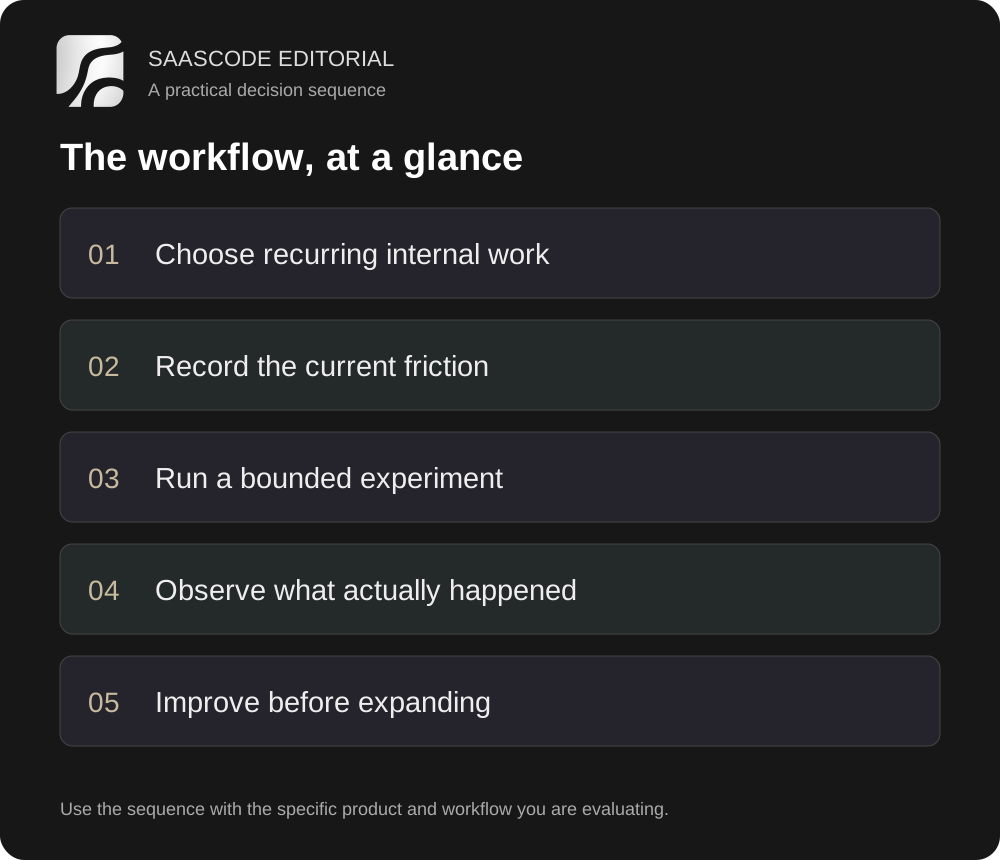
Observe friction before adding features
Once a real internal trial begins, keep a short operating log. Record the action, expected result, actual result and workaround. Avoid turning every annoyance into a feature request immediately.
Several observations may share one cause. If people repeatedly ask whether a submission became a task, a visible destination reference may help more than a new dashboard. If the same event creates duplicate work, fix the identity and retry contract before polishing the interface.
Google’s guidance on helpful content is relevant to how this work becomes editorial material: explain the experience and evidence that make the article useful. A case should contain what the team actually did and learned.
Keep an honest case record
A useful case record identifies the users, task, product versions, configuration, duration and observations. It separates measured outcomes from expectations. If the team stopped using a workflow, the reason may be as informative as a success.
When publishing a custom project, distinguish the original product’s capability from the work added for the case. A reader should not buy a catalog product expecting an integration that existed only in your custom implementation.
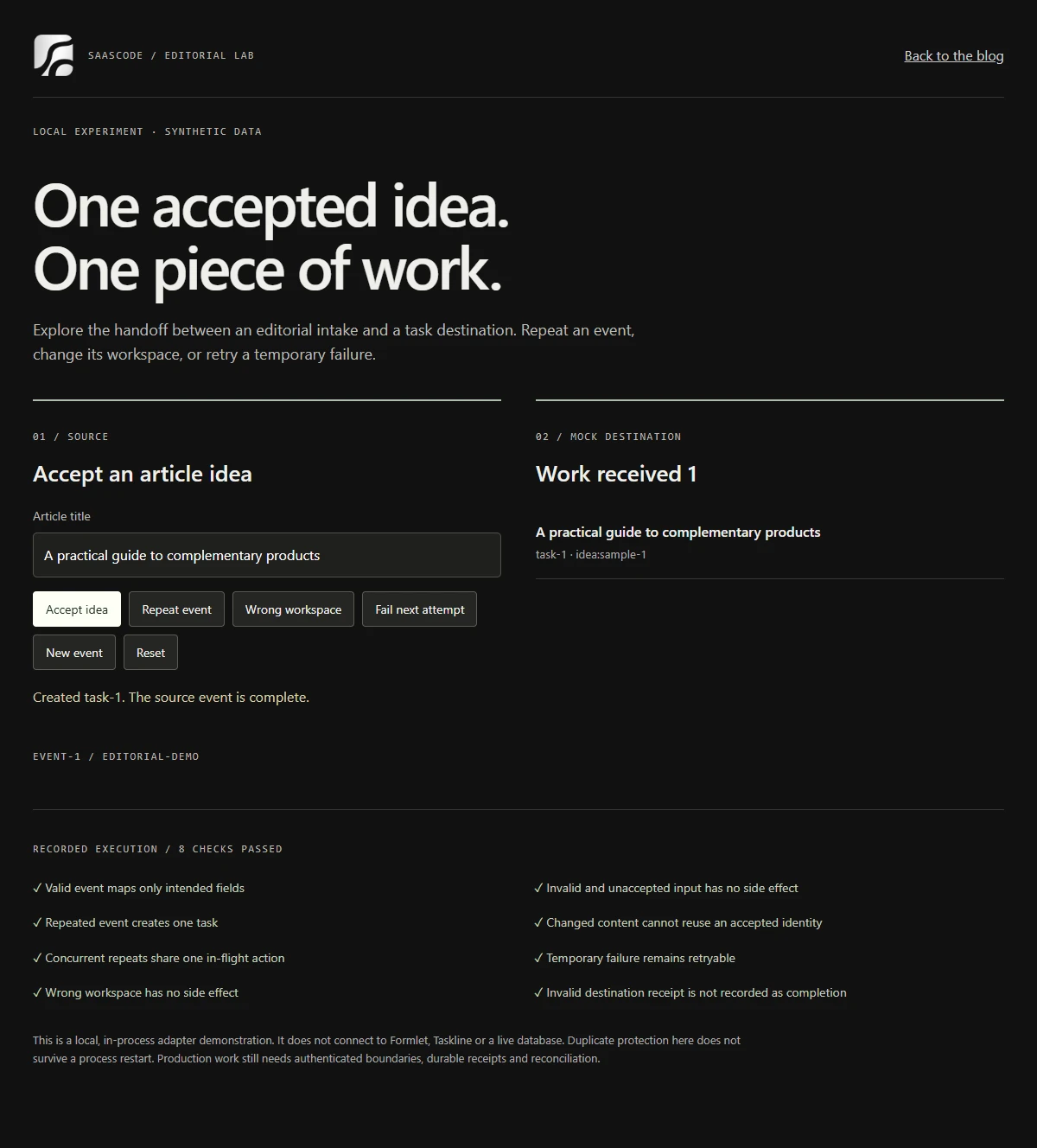
Actual screenshot of our local synthetic experiment, September 12, 2026. The destination is a mock; this is not the Formlet or Taskline interface.
Expand only after the first workflow earns its place
A working intake-to-task flow might justify a later status notification. It does not automatically justify a shared customer database, a billing bundle or another business.
Use the complementary-product framework to decide what kind of relationship comes next. If the opportunity is a new offer, review the second-product criteria.
For SaaSCode, the editorial opportunity is to show this work as it becomes real: the starting product, the custom change, the observed behavior and the remaining operational work. A modest reproducible experiment is a better first case than an unmeasured story about a fully connected ecosystem.
Editorial collaborations
Something useful to add?
Bring a documented case, an expert perspective or a better source to the SaaSCode blog.
Editorial collaborations