

On this page
A SaaS launch budget needs four parts: one-time setup, recurring services, usage-driven costs, and people time. The price of the code belongs in the first part. It does not tell you the cost of the service you will operate.
You can make a useful first budget without pretending to know future traffic. List the cost drivers, state the assumptions, and calculate a few scenarios. Then replace estimates with quotes and measured usage as you learn. This article provides a planning method and a hypothetical worked example, not a SaaSCode price quote or a revenue forecast.
Start with the customer action you will support
A dashboard with mostly text records and a service that processes long videos can have very different operating costs, even with the same number of customers. Model the work users will perform before selecting a hosting budget.
Write the main actions in plain language: create a record, upload a file, generate a report, send a message, make a payment. For each action, identify which service runs, what it meters, and whether retries also consume resources.
You do not need precise forecasts to expose a dependency. You do need to know whether its bill grows with stored gigabytes, delivered messages, compute time, generated outputs, transactions, or another unit.
Put each expense in the right bucket
| Bucket | Items to consider | How to record it |
|---|---|---|
| One-time acquisition and setup | Product license, implementation, migration, launch design, initial review | Quote or explicit assumption; cash due date |
| Recurring baseline | Application hosting, database plan, email plan, monitoring, support tools | Monthly charge and included usage |
| Variable usage | API calls, AI generation, bandwidth, storage overages, messages, payment processing | Quantity multiplied by the applicable unit price |
| People time | Support, maintenance, content, administration, incident response | Hours and an internal value or paid rate |
| Periodic and contingent costs | Domain renewal, backup storage, recovery work, specialist advice, refunds | Expected timing and separate allowance |
Some providers bundle several rows. Keep the included allowance visible so you do not count the same usage twice. A monthly plan with an allowance should generally be modeled as its base charge plus applicable overages, not its base charge plus every unit at the overage rate.
SaaSCode's catalog purchase supplies the application under its license; the terms make clear that you operate it on your infrastructure. Use the current product page and checkout for the acquisition amount. Do not copy a historical catalog price into your budget.

Leave room for maintenance and surprises — an editorial oil illustration.
Keep cash spending and the value of your time separate
Cash spending is what leaves the business account. Economic cost also includes the time you put into the service, even if you do not yet pay yourself. Both views are useful, but they answer different questions.
A basic model is:
First-year cash requirement = one-time cash costs + recurring cash costs + usage costs + planned allowances.
First-year economic cost = first-year cash requirement + unpaid hours × chosen hourly value.
Do not add contractor time again if its invoice is already in cash costs. If you pay yourself through the budget, avoid counting the same hours twice.
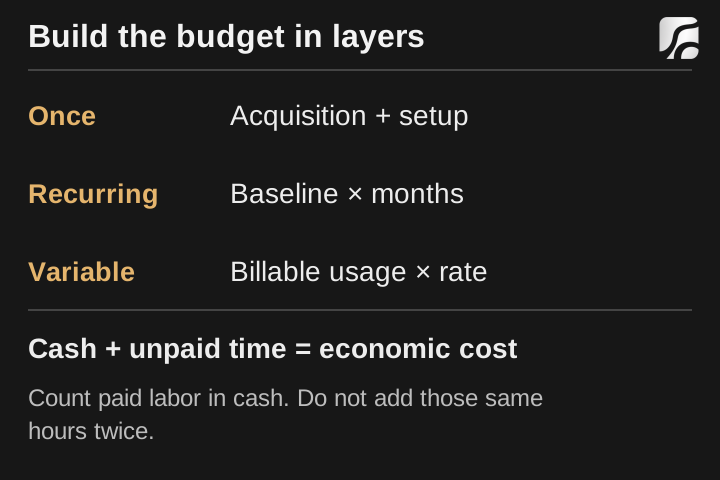
Editorial diagram: separate the cost drivers before adding them. People time may be paid cash or an additional internal cost, but should not be counted twice.
A worked example with explicit assumptions
Consider a hypothetical small service. The numbers below are chosen solely to demonstrate the calculation. They are not market averages, SaaSCode prices, provider quotes, or evidence from an operating business. All amounts are USD, and the scenario assumes the same usage each month for twelve months.
| Assumption | Calculation | Amount |
|---|---|---|
| Source license and initial setup, paid once | Chosen planning input | $600 |
| Hosting, database, email, and monitoring baseline | Chosen combined monthly input | $90/month |
| Domain and other planned annual cash costs | Chosen annual input | $60/year |
| Billable external actions | 5,000 actions × $0.004, beyond any included allowance | $20/month |
| Successful payments | 50 transactions × $20 | $1,000/month in gross receipts |
| Hypothetical processing charge | 3% of $1,000 + 50 × $0.30 | $45/month |
| Unpaid operator time | 8 hours × $30 internal hourly value | $240/month |
The payment fee is a deliberately hypothetical rate, not a quoted provider tariff. The example assumes all fifty payments succeed and there are no refunds, disputes, tax adjustments, or currency conversion. Gross receipts appear only to calculate the variable fee; they are not a prediction of sales.
Monthly operating cash in this scenario is $90 + $20 + $45 = $155. The first-year cash requirement is $600 + $60 + 12 × $155 = $2,520. Adding the unpaid time gives an economic cost of $2,520 + 12 × $240 = $5,400.
That result covers only the listed scope. It excludes marketing spend, initial unpaid setup time, taxes, refunds, disputes, legal or accounting fees, and contingency. Add any of those that apply to your plan. Calling the result a complete company budget would hide those exclusions.

Fixed commitments and usage vary differently — an editorial oil illustration.
Test the assumptions that could hurt
Change one driver at a time so you can see why the result moves. Using the same hypothetical example:
| Scenario | Changed assumption | Monthly operating cash | Monthly cost including unpaid time |
|---|---|---|---|
| Planning case | Inputs above | $155 | $395 |
| No paying customers yet | No payment fees; baseline and test usage continue | $110 | $350 |
| More external usage | 20,000 billable actions; other inputs unchanged | $215 | $455 |
| More support work | 20 unpaid hours; cash inputs unchanged | $155 | $755 |
These are arithmetic scenarios, not a forecast of what users will do. Notice that an increase in support work changes economic cost without changing the cash column when the operator remains unpaid. A contractor taking on that work would move some of it into cash spending.
The no-customer case is useful for planning how long you can keep operating. Work from your own available cash and expected spending over time. Do not assume revenue will arrive simply because the product is ready to accept payments.
Check provider terms before treating free as a launch budget
A free tier may be useful for evaluation, but commercial eligibility and resource limits matter. Vercel's Hobby documentation, checked for this guide, restricts that plan to personal, non-commercial use. An application that runs during a test therefore does not establish that the same plan fits a commercial launch.
Supabase's pricing page separates plan charges, compute, included usage, and overages. Use the combination your architecture requires, including separate projects where relevant. The headline plan price is only one input.
Likewise, Stripe's pricing distinguishes payment methods and additional charges such as international transactions or currency conversion. Check the terms for your account, country, and payment flow. A provider processing the purchase of your source code is also a separate relationship from the provider you use to charge your own customers.
Record the date, currency, plan, allowance, and source URL beside every real rate you use. Recheck the rows before launch and when your usage pattern changes.
Email illustrates why a provider name is not a budget line. Resend’s pricing documentation describes paid-plan overages in additional buckets of 1,000 emails. Estimate messages per customer action, monthly volume, the included allowance, and the next billing threshold using the current plan. Other providers can meter the same workflow differently. Keep those units beside your assumptions, then connect the budget to your launch sequence.
Turn the worksheet into an operating habit
Before purchasing, fill in acquisition, required services, and the adaptations you expect. Before launch, replace those estimates with the actual account plans and implementation quotes. During a controlled pilot, measure the billable actions and support time behind one complete customer journey.
After launch, compare the plan with invoices and usage records. A cost increase should lead to a specific question: more users, heavier activity, repeated failed requests, a new provider tier, or more time spent helping customers? Each cause calls for a different decision.
When reviewing a SaaSCode product, put its documented integrations and remaining setup work into the worksheet. The buying guide explains that handover, while the evaluation checklist helps establish which assumptions still need evidence. A useful budget makes those unknowns visible early enough to act on them.
What changes when you operate a second product?
Estimate the additional service accounts, support work, maintenance and recovery procedures. A shared audience does not automatically create shared infrastructure. Our second-product decision guide connects that incremental work to the customer need that would justify it.
Editorial collaborations
Something useful to add?
Bring a documented case, an expert perspective or a better source to the SaaSCode blog.
Editorial collaborations