

On this page
Buying SaaS source code gives you a software product you can deploy and adapt under its license. You still need to set up its infrastructure, configure the services it uses, serve your customers, and maintain the installation. The useful question is how much of your intended workflow the delivered application already solves.
That distinction matters if you are comparing a finished application with a hosted subscription or a starter kit. A subscription buys access to somebody else's operated service. A source-code purchase puts more of the application under your control and more of the operating work on your desk.
A source-code purchase is also different from acquiring a running SaaS business. Do not assume that customers, revenue, a domain, or existing provider accounts transfer with the application. Write those assets into the offer if they are part of a separate acquisition; this guide concerns the software purchase.
What should arrive with the purchase?
Start with the delivery itself. You need a usable application and enough information to understand its boundaries. A polished demo helps you evaluate the interface; the documentation should explain what is required to run that interface in an environment you control.
| Item to inspect | What it helps you establish | What it does not establish by itself |
|---|---|---|
| Application source | Which workflows and integrations are implemented | Whether they fit your business without changes |
| Installation instructions | Supported runtime, setup order, and required services | A completed deployment in your accounts |
| Configuration guide | Which settings and credentials you must supply | Provider approval or included provider usage |
| License | Permitted operation, modification, and delivery | Exclusive ownership of the vendor's intellectual property |
| Release notes and update terms | What changed and how releases are supplied | A promised schedule of future features |
| Support terms | Which questions and defects the seller handles | Managed hosting or an on-call engineering team |
These are inspection categories, not a claim that every seller packages the same files. Compare the actual product page and delivery terms against the work you need to do. If an essential document is unavailable before purchase, ask what it covers and record the answer.
SaaSCode sells finished applications with source included as a one-time purchase. You download and run the product on your infrastructure. Its Terms of Service explain the delivery, license, updates, and support boundaries; the catalog is the place to inspect a particular application.
Review the terms before committing — an editorial oil illustration.
Source access and commercial rights answer different questions
Having the source lets you inspect and change the software. The license determines how you may use it. Keep those questions separate when reviewing an offer.
For SaaSCode products, you can modify the application and operate a business with it under the applicable license. Selling access to the service you run is different from distributing the underlying code. SaaSCode's license does not grant permission to resell, redistribute, sublicense, or give away the source itself. Read the product's license selection and section 5 of the terms for the rights and limits that apply to your purchase. Client work needs the appropriate product license; membership does not replace it.
Source included also does not mean open source. The Open Source Initiative's definition includes redistribution rights among its criteria. A commercial license that provides source with restrictions should be described by those actual terms.
A practical buying note has four lines: who holds the license, which business will operate the service, how it will be deployed, and who needs access to the code. If any of those lines depends on an assumption, resolve it before checkout.
What remains your responsibility?
Think of the handover in three parts: the delivered product, your setup, and your continuing operation.
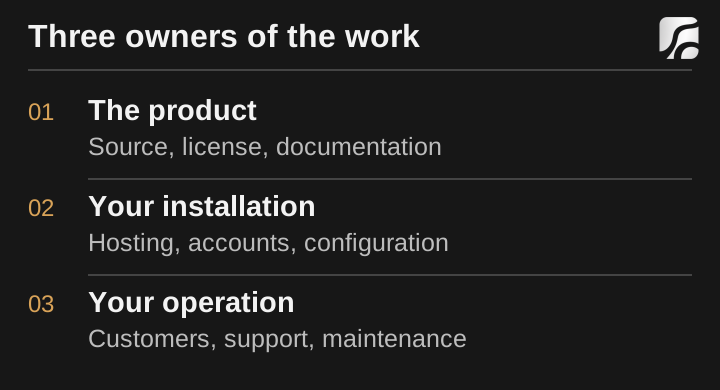
Editorial diagram: the purchase supplies the application; setup and operation turn it into your service.
Infrastructure and service accounts
The application needs somewhere to run. Depending on its documented architecture, that may involve application hosting, a database, file storage, transactional email, and external APIs. An integration in the source is a connection the software knows how to make. You still need an eligible provider account, working credentials, and a budget for its usage.
Record each dependency and its owner. If payments are central to your service, verify that your intended provider supports your business and location before making it a launch assumption. If email is essential to onboarding, include sender setup and a delivery check in the plan.
Configuration and your customer experience
Your brand, domain, sender identity, commercial offer, and customer policies need to match the service you will actually provide. Demo content is useful for learning a workflow, but it is not your launch content.
For example, imagine you want to operate a scheduling service for independent tutors. This is a hypothetical business, not a reported SaaSCode customer. A suitable application might already handle availability and reservations. You would still need to confirm how it treats cancellations, time zones, rescheduling, and access for assistants. A name change does not answer those questions.
Write a short acceptance scenario: a tutor opens availability, a student reserves a slot, the tutor changes the appointment, and both receive the right information. That scenario is more useful than a long list of loosely related features.
Maintenance and recovery
Once customers rely on the service, someone must watch errors, handle support, review updates, protect account access, and recover data when something goes wrong. Assign that work even if you initially do it yourself.
A backup label deserves a closer look. For example, Supabase documents that its database backups exclude files stored through its Storage API. If your application relies on uploaded files, you need to account for those separately. This is one reason a provider's feature list cannot replace a recovery plan for your whole application.
SaaSCode's support and update terms cover the shipped product within defined limits. They do not make your deployment a managed service or promise compatibility with every future provider change. Plan who will review and apply an update to your modified installation.

Receiving a package is different from operating it — an editorial oil illustration.
When buying source is a good fit
The fit is strongest when the application's core workflow already matches your need, you value control over its behavior and branding, and you have a credible path to maintaining it. That path may be your own technical capability or someone you contract to do the work.
The fit is weaker when you only need a tool to use today and do not want responsibility for its operation. A hosted service may serve that situation well. It is also weaker when the product's central data model conflicts with your business; extensive changes can consume the advantage of starting from a finished application.
Before deciding, put the remaining work into three lists:
- Configure: supported settings, branding, provider accounts, and content.
- Change: workflows or behavior that require implementation.
- Operate: recurring technical and customer work after launch.
Estimate each list independently. A low purchase price cannot tell you how long a missing workflow will take or how much support your customers will need. The launch cost worksheet gives you a way to make those assumptions visible.
Make the next step a product check
Open one application in the SaaSCode catalog and compare it with your acceptance scenario. Read its description, try its demo through the provided link, inspect its public record, and list the work left on your side. Bring unresolved delivery or license questions to support before purchasing.
If the delivery model fits, use the source-code evaluation checklist to turn interest into a decision with evidence. You should finish that review knowing what you are buying, what you will change, and who will keep it running.
Buying a foundation for your own variant
You may want the documented product as it stands, or its source as a foundation for a specific adaptation. If you expect to extend it, investigate the workflow and license first, then plan a bounded customization. Include the ongoing work of maintaining a private fork in that decision.
Editorial collaborations
Something useful to add?
Bring a documented case, an expert perspective or a better source to the SaaSCode blog.
Editorial collaborations