

On this page
A private SaaS fork is a working copy of source code that you adapt for your own permitted use. Its long-term value depends on whether you can still understand, update and operate it after the first customization.
The word “fork” describes a development relationship here. It is not permission to publish purchased code or redistribute a derivative package. Check the applicable SaaSCode terms and the product’s license before deciding how your variant will be distributed.
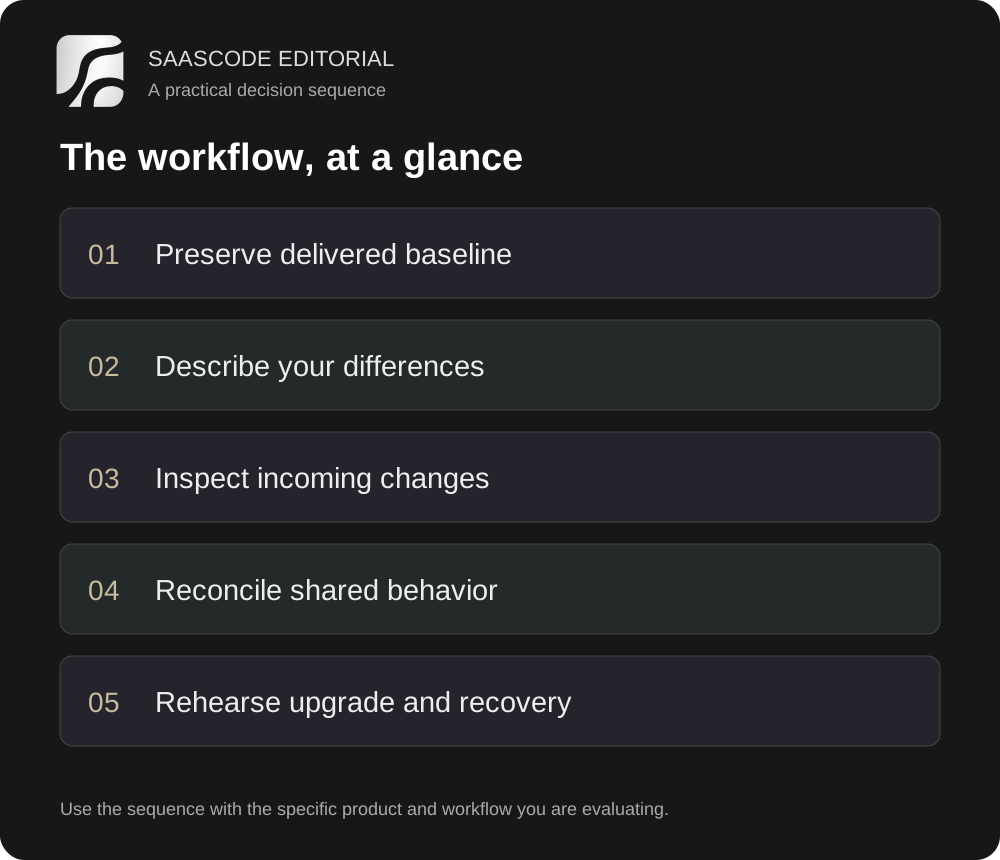
Preserve a baseline you can identify
Keep a record of the delivered version and the documents that came with it. When a workflow behaves unexpectedly, you need to distinguish behavior inherited from the product from behavior introduced by your changes.
A baseline also makes an upgrade review possible. Without one, a developer may know that two directories differ but not why. A useful change note connects each difference to a business need: an extra review step, a field required by a niche, or a new integration boundary.
If you are still deciding how much to customize, read how to adapt a SaaS to a niche. The smallest useful difference is usually easier to maintain than a broad redesign made before observing real users.

Inspect the details that determine the result. Editorial oil illustration.
Separate presentation from business behavior
Changing colors, labels and editorial content is different from changing permissions, billing or data relationships. Record those categories separately because their upgrade risks differ.
An upstream visual improvement may be easy to adopt around your branding. A change to the same permission rule you customized requires a behavioral decision. You need to understand which version reflects your current operating requirements.
Avoid editing the same shared primitive in many inconsistent ways. Prefer an existing extension point when the application provides one. Where no extension point exists, a small explicit customization can be clearer than a new abstraction created for a single use.
Review updates by consequence
Do not treat an incoming version as a pile of files to copy. Read its release notes, migration instructions and changed dependencies. Identify which workflows your variant shares with the changed code.
| Incoming change | Review question | Useful evidence |
|---|---|---|
| Dependency update | Does the public API or runtime requirement change? | Release notes and affected checks |
| Schema migration | What happens to existing records? | Rehearsal on representative synthetic data |
| Permission change | Which actors gain or lose access? | Role-specific workflow tests |
| UI revision | Are your custom fields and empty states preserved? | Desktop and mobile inspection |
| Integration change | Do retries and payloads still match? | Contract and failure-path checks |
The Git documentation on merging explains the mechanics of combining histories. A conflict-free merge only establishes that the tool could combine text. It does not establish that the combined behavior is correct.
Keep a small regression set
Choose a few workflows that represent the business. For a job board, that might mean an employer creates a listing, a candidate applies and an operator reviews the result. Add a check for each custom behavior you intend to preserve.
Include failures that have already caused trouble. A regression example should survive changes in implementation when the desired behavior remains the same. Avoid a huge suite that only mirrors internal function names and becomes expensive to maintain.
An AI coding agent can help trace changes and draft patches. Give it the baseline, your change notes and the acceptance examples. Ask it to identify uncertainty before rewriting a shared behavior.

Follow the work through to an observable outcome. Editorial oil illustration.
Rehearse recovery as part of the upgrade
A code rollback may not undo a data migration or an external side effect. Write down what can be reversed, what needs a backup and what requires a forward correction.
Use a separate environment with representative data shapes. Verify startup, the core workflow and any changed service boundary. Keep the previous deployable artifact and the recovery steps accessible to the person performing the release.
The launch checklist and operating-cost guide help connect these technical steps to ownership and budget.
When should you reconsider the fork?
If every update requires reworking the same large portion of the application, inspect whether your business has moved beyond the original product’s domain. That is a reason to reassess architecture and scope, not an automatic reason to abandon the product.
Maintain a short answer to three questions: what did we change, why does the business need it, and how do we know it still works? A fork that can answer them remains a practical foundation instead of becoming an unexplained copy.
Editorial collaborations
Something useful to add?
Bring a documented case, an expert perspective or a better source to the SaaSCode blog.
Editorial collaborations