

On this page
To adapt a SaaS to a niche, begin with a recurring job that a specific group struggles to complete. Compare that job with the existing application's workflow, classify the gaps, and test the smallest coherent adaptation with likely users.
A new logo and industry vocabulary can help people recognize the offer. They cannot establish that the application supports the way those people work. Source access gives you room to make changes, but it does not tell you which changes are worth making.
The example below uses a hypothetical job board for outdoor education employers. It is an illustration of the method, not a reported customer project or a claim that this market has been validated.
Start with a recent task, not a list of desired features
Suppose you want to serve organizations hiring instructors for seasonal programs. “Better hiring software” is too broad to guide an adaptation. A more useful question is how those employers handled their last vacancy and how candidates decided whether to apply.
Ask an employer to walk through a recent posting: who prepared it, which details were missing, where applications arrived, and how the team decided what to do next. Ask a candidate how they checked dates, location, pay and eligibility before spending time on an application.
With permission, inspect the documents or tools used in that task. A spreadsheet with repeated manual corrections is evidence of work. “I would probably use an AI dashboard” is a suggestion that still needs investigation.
The GOV.UK guide to in-depth interviews recommends open, neutral questions and attention to real stories. Apply that discipline here. Keep what participants did separate from what they think they might do.
This is the practical starting point for vertical SaaS: software shaped around the work of a particular industry or profession. Eric Migicovsky’s Y Combinator session on talking to users focuses on concrete experience rather than pitching an idea. Ask the person to reconstruct their most recent difficult task, show the workaround, and explain what happened next. Those answers give your adaptation a workflow to test.
Eric Migicovsky — How to Talk to Users
Write the niche in operational terms
A useful niche definition contains an actor, situation, task and constraint.
For this hypothetical board:
An outdoor education employer needs to recruit for a program with fixed dates, while candidates need to understand location, pay and prerequisites before applying.
That statement creates a manageable research scope. It does not assume automatic qualification checks, background screening, payroll or worker placement. Each would introduce another job and another set of responsibilities.
Write the offer at the same level of specificity. “Find seasonal program roles with clear terms” gives you something to test. “The complete operating system for outdoor education” creates obligations the starting product may never have been designed to meet.

Make the smallest change that fits the workflow — an editorial oil illustration.
Map the existing product before changing it
Vacanta is a public SaaSCode product designed around employer vacancies, moderated publication and candidate applications. Its product page describes the workflow and its boundaries. That makes it a relevant example to examine for the hypothetical board, without establishing that every niche requirement is already included.
Use a fit map like this:
| Niche requirement | What to inspect in the starting product | Likely decision |
|---|---|---|
| Candidates understand pay and workplace | Visible vacancy information | Keep the existing behavior if it expresses the requirement |
| Employers use the right role vocabulary | Available categories, fields and presentation | Configure where supported; otherwise estimate a change |
| The board maintains listing standards | Submission and moderation workflow | Define an operating policy, then check that the UI supports it |
| Program dates must be searchable | Exact fields, validation and filtering | Confirm support; do not assume a date mentioned in text is filterable |
| A certificate must still be valid on the start date | Data model and verification requirements | Treat as a proposed extension until designed and tested |
| The operator places and pays workers | Whole product model | Reconsider the starting point; this is broader than a posting board |
The right-hand column is a decision aid, not a feature statement about Vacanta. Confirm each relevant row against the current product and an isolated implementation.
Separate three kinds of adaptation
Configuration uses controls the product already exposes. Examples might include approved branding, published categories or supported pricing options. Check the actual controls first.
Code changes introduce behavior: a field with validation, a new filter, a different permission or an integration. Describe the change through every place the value travels, including forms, storage, search, notifications, exports and deletion.
Business-model changes alter who receives value, who pays, or who is responsible. Turning a posting board into a staffing service belongs here. It can require a different product even if both businesses use the word “jobs.”
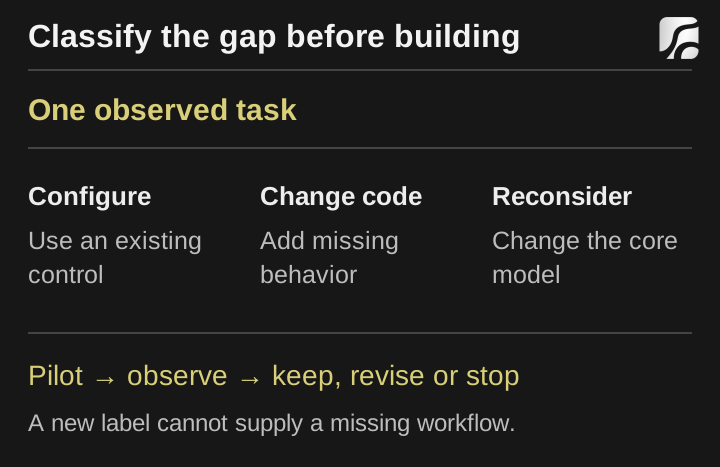
Classifying the gap before implementation keeps a vocabulary change from quietly becoming a new business system.
A change can cross categories. Adding a certificate upload might look like one new form field, but it also creates questions about access, retention, expiry and who checks the document. Estimate that whole workflow before describing the feature as included.
Preserve the useful boundaries of the original product
When adapting a product, identify the rules that keep its workflow coherent. In a job board, the relationship between a vacancy, an employer and an application matters more than the color of a category label.
Vacanta's public description distinguishes a private employer applicant pipeline from an unrestricted candidate database. If your niche asks for a searchable pool of every candidate, treat that as a material change with its own permissions and consent requirements. A renamed navigation item does not answer those questions.
Search distribution has boundaries too. Google's JobPosting guidance requires job content to match its markup, provides rules for expired listings, and requires a way to apply. If you change the public vacancy page, preserve the relationship between what people see and what the structured data says. Structured data is not a guarantee of search placement.
Avoid adding a compliance claim because an existing form contains a related field. A field for a certificate is not a credential-verification service. A policy setting is not proof that the resulting business meets every requirement in its market.

Observe the bottleneck before designing a feature — an editorial oil illustration.
Test one complete niche journey
Prepare a small pilot around one believable task. Use invented records in an isolated environment, label them as test data, and include the people who would actually perform the work.
For the hypothetical board, an employer prepares a seasonal instructor vacancy. A reviewer decides whether its terms are sufficient. A candidate decides whether the role fits and attempts the application. The employer then finds the application and determines the next action.
Observe the points where people hesitate or need help. Do candidates look for program dates in the wrong place? Does the employer understand which prerequisites must be stated? Does the reviewer have enough information to make a decision?
Use a pilot note with four fields:
- Observed behavior: what the person actually did.
- Consequence: how it affected the task.
- Proposed change: the smallest change that addresses it.
- Retest: how you will know the change helped.
“Participant could not distinguish program dates from the posting expiry date” is useful. “The design needs to feel more premium” needs a more concrete explanation before it can guide work.
Check the offer as carefully as the interface
The pilot should also test whether the buyer understands what is being sold. Explain the price structure you propose, who pays, what the service includes and how support works. Record questions and objections without turning a polite response into proof of demand.
Operational work may be your strongest early adaptation. A focused set of employer relationships, clear posting standards and careful onboarding can make an existing workflow useful before it needs extensive new code.
If you buy a SaaSCode product, modification and commercial operation remain subject to its license. Source-included products are starting points for operating a business; they do not confer source redistribution rights. If the required changes extend beyond your team's capacity, Hire the Factory is a route to discuss a separate engagement.
Decide what to keep, revise or stop
Keep an adaptation when the pilot supports a clear task and the operating work is manageable. Revise it when a specific gap prevents completion. Stop or change the starting product when the core requirement repeatedly fights its data model or business boundaries.
For the hypothetical board, a supported category change and clearer posting instructions might be enough for an initial pilot. Mandatory qualification verification or worker placement would justify a separate scope decision. Neither outcome is a failure of the exercise; both reduce the chance of buying the wrong starting point.
Open a candidate in the catalog, write its central workflow beside one observed niche task, and fill the gaps before editing the code. Use the demo rehearsal to test the fit. The aim is a product that supports a particular group with fewer unresolved assumptions.
Could the same audience need a complementary product?
A niche can reveal another need before or after the main workflow. That might justify a helpful referral, an internal tool or a focused integration. Use the complementary SaaS product guide to distinguish these relationships before creating another business. If the change belongs inside the first product, keep it there and plan how to maintain the customized source.
Editorial collaborations
Something useful to add?
Bring a documented case, an expert perspective or a better source to the SaaSCode blog.
Editorial collaborations