On this page
SaaS onboarding should help a new customer complete one useful job and understand how to do it again. Choose that result before designing a welcome tour, setup checklist or email sequence. Ask for the information needed to reach it, make the outcome easy to find, and give the customer a clear next step when something goes wrong.
For a form service, creating an account is setup. Submitting and finding a marked test response is a rehearsal. Receiving a real request that the owner can understand and act on is the first useful customer result. Those are three different milestones, even if they happen in the same session.
This guide develops a proposed first-session journey for an agency using a form service based on Formlet. It is an editorial design example, not an existing Formlet onboarding wizard or a customer experiment. SaaSCode offers Formlet; the suggested copy and adaptations below have not been implemented in the product.
Start with the result the customer came for
Imagine a small agency wants clients to send website-change requests without burying the brief in messages. Its first useful result is not a beautifully branded form. It is a request the person responsible can locate, interpret and answer.
Define the outcome in the customer's vocabulary: “I can open a client's request, understand which website needs changing, and decide what to ask or do next.” This leaves room for a legitimate clarification. A request does not have to be accepted for delivery to be useful.
Formlet's public product page describes form building, publishing, sharing and response review. Those capabilities make this a concrete workflow to design around. They do not establish that the proposed onboarding sequence already exists. An operator adapting the source should verify their running version before promising a specific screen or behavior.
If the audience or underlying job is still uncertain, return to finding the first paying customers for a niche SaaS. Onboarding can make a relevant service easier to use; it cannot supply a reason to need it.
Give the first session a small, complete scope
For this agency, a reasonable first session is to prepare one request form, submit an unmistakable test entry, and have its owner find and explain the answer. A real client request comes afterward, once the agency is ready to receive it.
Keep the first form focused on the decision the owner must make. A website or project name and a description of the requested change may be enough for a rehearsal. For live use, add the contact and context the agency actually needs. Label a requested date as a preference to review, not a confirmed deadline.
The operator should decide which setup is essential before that journey and which can wait:
| Needed for this first journey | Usually a later step for this example |
|---|---|
| A working account with access to the right workspace | Inviting the whole company |
| One form with meaningful questions | Building every form the agency might eventually use |
| A working published link and a place to review responses | Embedding the form on several websites |
| A named person responsible for checking the answers | Automating the transfer into a project-management system |
| Appropriate access and data-handling settings for the intended use | Refining visual branding beyond what the first use requires |
“Later” is contextual. If a customer cannot use a service without a particular access control, that control is a prerequisite. Do not postpone it merely to make the onboarding flow look shorter. Likewise, an existing customer with a ready form should be able to continue from their actual state instead of recreating it to satisfy a welcome checklist.
Make an empty screen explain the next action
An empty response list is expected before anyone has submitted a form. It becomes confusing when the screen gives no clue about what creates a response or where the user should go.
Proposed guidance for a newly published form could read:
See one response arrive. Open your published form and send a clearly marked test entry. Then return here to find it. Use invented details; do not invite clients until you are ready to receive their requests.
The main action could be “Open published form,” followed by a visible route back to responses. If the form is still a draft, the next action should be to review and publish it instead. A button that assumes a public link exists would send the customer into a dead end.
The important design choice is that the guidance responds to the current state. A customer who already has a response needs help finding or interpreting it, not the same invitation to create another test. Any automatic detection or state-specific copy described here would need to be implemented and checked in the operator's version.
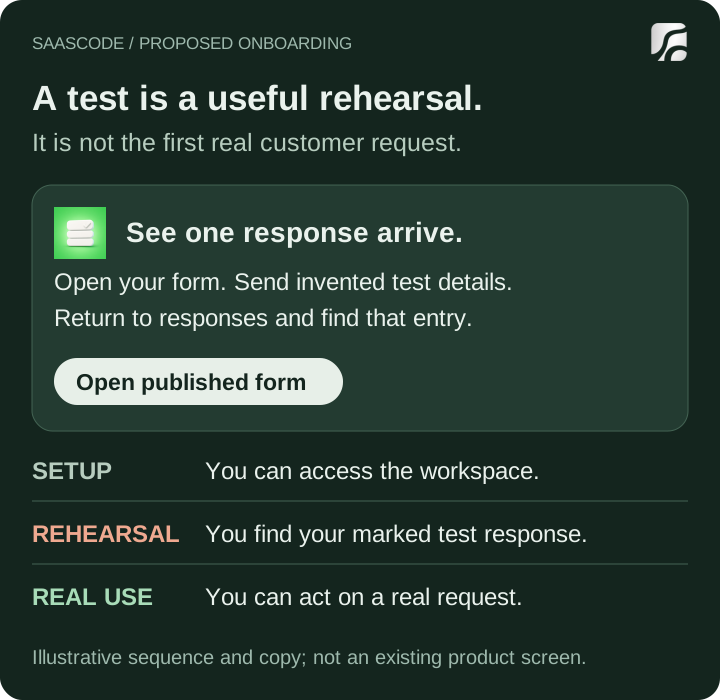
Original editorial proposal. Setup, rehearsal and real use answer different questions. This is not a shipped Formlet onboarding screen or measured customer funnel.
Avoid turning the whole product into a mandatory tour. Offer help near the action that needs it. The customer can explore other features after completing a small loop they understand.
Close the loop between submitting and finding
Use a test label the owner will recognize, such as “TEST — Homepage update.” Submit invented details through the intended respondent path, then return to the response view and find that exact entry. Do not use confidential client material to populate a rehearsal.
The proposed exercise should end with the owner explaining what arrived, where to find it again and what they would do with a comparable real request. Seeing a success message on the respondent's screen is only one side of that loop.
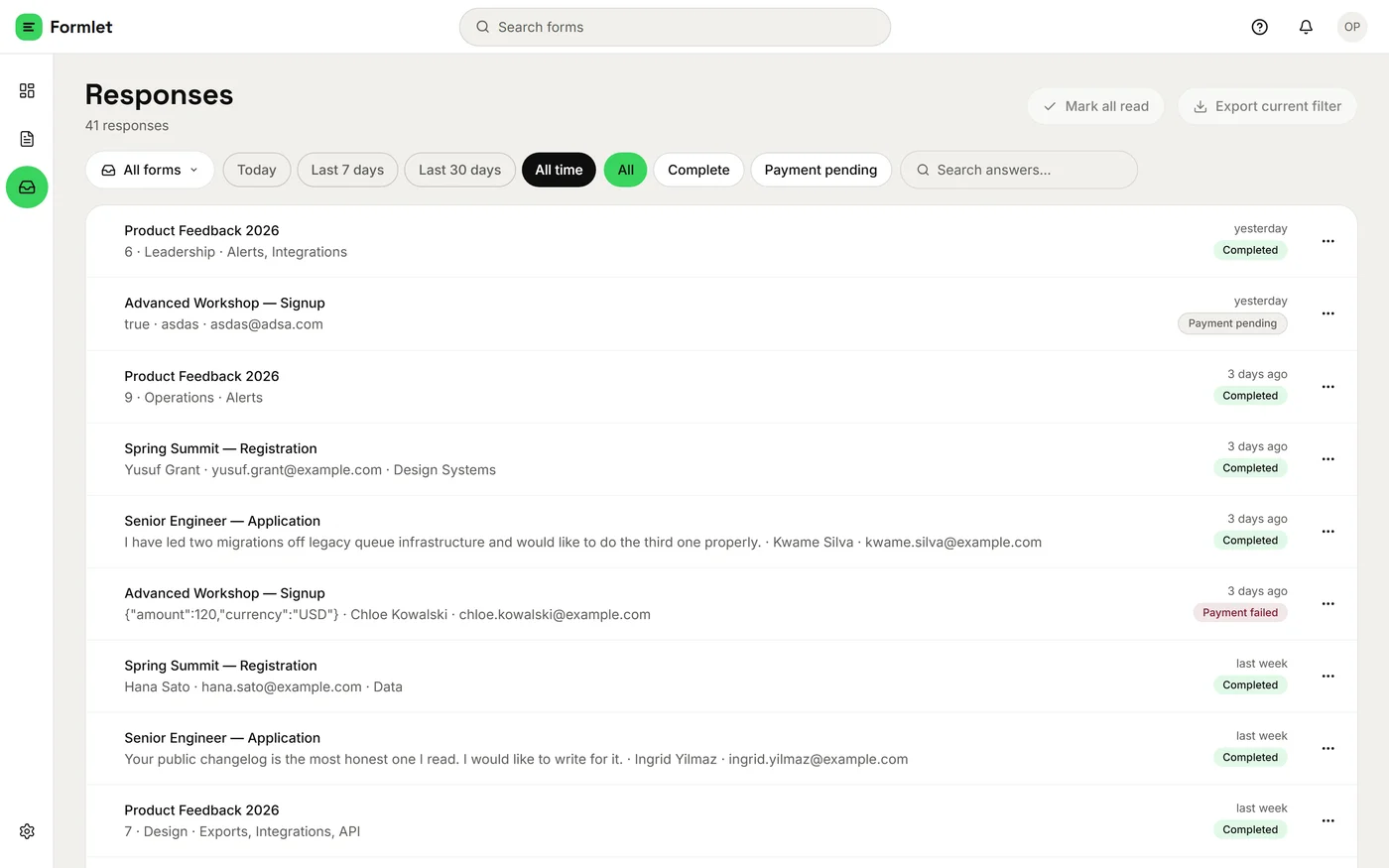
Formlet's published catalog screenshot, retrieved October 9, 2026. It shows demo records in the response view. It is a product reference, not evidence that we submitted or processed a request in this article.
The GOV.UK confirmation-page pattern emphasizes making completion and next steps clear. Applied to this example, the respondent should understand that a request was received and what happens next. The agency owner separately needs a reliable way to inspect it.
A proposed respondent message might say:
Your request has been received. The team will review the details and reply using the contact information you provided. A requested date is not a confirmed delivery date.
Only include a response-time promise the team can meet. Do not say that an email was sent unless sending it is part of the actual workflow and its status supports that statement. A confirmation should describe what happened, rather than what the interface hopes will happen next.
For the rehearsal, decide how test entries will be identified and handled before inviting real clients. This article does not assume a built-in test mode or that deleting a test reverses every counter or side effect. Check the product's actual behavior and keep test activity out of the record you use to judge real adoption.
Plan the recovery path before adding another prompt
When a user stalls, identify the blocked job. A reminder to “finish setup” is not helpful if the real problem is that the public form cannot be opened or the user is looking in the wrong workspace.
For the proposed form journey, different failures deserve different responses:
| What the customer encounters | Help that addresses the problem |
|---|---|
| A required answer is missing | Identify the field and keep the answers already entered available for correction |
| The intended form has not been published | Explain the missing step and return to its review/publish path |
| A response is expected but not visible | Check the form, workspace and active filters before asking for another submission |
| The user lacks access to review responses | Explain who can provide access; do not suggest bypassing permissions |
| The service is unavailable | Explain the service problem and how to resume or get help; do not blame the user's form answers |
The GOV.UK validation guidance recommends telling people what to fix while preserving their entered answers. It also distinguishes validation from eligibility and permission problems. Those distinctions help here: a malformed answer, missing access and an outage should not collapse into the same generic error.
Treat the table as a proposed review of the operator's experience, not a claim that Formlet currently has these failures or already implements every suggested recovery. A developer can use the actual customer obstacle to scope a small adaptation. The niche-adaptation guide helps separate configuration from a change in product behavior.
Offer help without hiding who did the work
Some customers need a short setup conversation. That can be part of a good service, provided the support boundary is clear. For this example, an operator might offer help choosing the first questions and locating the resulting response, while leaving a website redesign or custom integration outside that session.
During an assisted session, let the customer perform the steps they will need later. If you publish the form, submit the test and find the answer while they watch, you have demonstrated the product. You have not learned whether they can repeat the job.
Record where help was needed: choosing questions, understanding publication, finding responses or deciding how to reply. Those observations lead to different changes. A missing label might justify clearer copy. A team with no agreed reviewer needs an operating decision. A request for automatic task creation belongs to a separate implementation discussion.
The client-intake comparison explores where the work goes after collection. The first session here deliberately stops earlier: the owner can find and interpret the request. It does not claim that collection automatically approves, assigns or completes the requested work.
Measure the milestone you actually observed
Keep setup, rehearsal and customer use separate in your operating record. Account creation shows access. A successful test shows that a particular path worked with invented input. A real request reviewed by its owner is evidence of the intended job. A later independent repeat tells you something more.
For a first group of customers, record the milestone reached, whether it used test or real input, whether help was required and the specific obstacle if the journey stopped. Decide the qualifying result before counting it. For this agency, merely opening the response page would be weaker than locating the intended request and identifying the next action.
Do not label every account “activated” because a checklist reached 100%. Equally, do not treat an agency as unsuccessful simply because no client had a request during its first day. The observation window needs to reflect when the customer's work occurs. If the opportunity has not happened yet, that is different from an attempted journey that failed.
Our first-month SaaS metrics guide develops the reporting side of this decision. Here, the immediate task is to choose one improvement grounded in what you observed, then check the next comparable first session. No completion rate, retention uplift or time-saving result is claimed by this proposed design.
SaaSCode's finished products give an operator a working software foundation to configure and, where needed, adapt. Good onboarding connects that product to the first job a particular customer needs to do. Start with a small loop whose result the customer can recognize, preserve a clear way to recover, and expand the experience after that loop makes sense.
Product references and primary design guidance checked October 9, 2026. All proposed onboarding copy and journey changes are editorial examples. No live customer session or Formlet submission was executed for this article.
Editorial collaborations
Something useful to add?
Bring a documented case, an expert perspective or a better source to the SaaSCode blog.
Editorial collaborations