
On this page
To find the first paying customers for a niche SaaS, start with people you can reach who already have a recurring problem your product can handle. Learn how they deal with it, offer a small paid pilot with a clear finish, and observe whether they use the service and want to continue at a stated price.
A finished application gives you something concrete to demonstrate. You still need a buyer, a reason to change, and an offer you can deliver. The first useful sale connects those three things without turning your software business into an open-ended custom project.
The situations and pilot below are hypothetical. They illustrate how to make the decision; they are not SaaSCode customer results or a promise of sales within a particular timeframe.
Choose a reachable buyer with a reason to act
“Small businesses” is an audience label. “Independent language schools coordinating adult trial lessons before their next intake” describes a situation you can discuss with a particular person.
Start with one group where you understand the work or have a credible introduction. Look for a recurring task, someone responsible for it, and a current reason to improve it. A new intake, a repeated client handover or an upcoming hiring round gives the conversation a concrete setting. It does not prove that the business needs your software.
These three situations would lead to different first conversations:
| Hypothetical buyer | Job worth investigating | A useful first contact | What might rule out a pilot |
|---|---|---|---|
| A language-school coordinator | Turn trial-lesson requests into confirmed appointments and follow-up | An introduction from a teacher or a relevant local business group | The existing booking tool already handles the job well |
| The owner of a small design agency | Collect client approval on one deliverable without losing the decision in messages | A professional relationship where you can discuss a recent project | Every client requires a different procurement or approval system |
| An employer hiring seasonal instructors | Publish clear roles and manage incoming applications | A trade community or an introduction from another employer | The actual need is a staffing service that sources and places workers |
Choose the situation where you can learn and deliver, rather than promising all three markets from one generic landing page. If product fit is still uncertain, use the niche-adaptation guide first. It explains how to distinguish a configuration change from a different product requirement.
Find conversations where the problem already comes up
For your first few conversations, use a channel you can explain. That might be an introduction from someone who knows the work, a community discussion about the exact problem, or a small event attended by that profession. Participate within the community's rules and be clear that you operate the product.
A relevant public question can tell you what to investigate. It is not permission to collect a large contact list or repeatedly pitch everyone in the group. Ask the person whether a short discussion would be useful, and make it easy to decline.
Carol Luong's sales advice for technical founders, published by Y Combinator emphasizes relevant prospects and understanding priorities, decision-makers and purchasing timing. Those are useful questions for a focused sales conversation. The article dates from 2017; its platform examples and conversion figures are not a current channel forecast for your business.
For a warm introduction, a message could look like this:
Maya suggested I speak with you about how your school handles adult trial-lesson requests. I run a small booking service and am exploring whether it fits independent schools. Would you be open to showing me how one recent request became a confirmed lesson? If the current process works well, that is useful to know too.
This is an illustrative message, not one we sent. Replace the introduction with a real one; do not invent a mutual contact. Its purpose is to earn a specific conversation, not to hide a sales pitch inside fake research.
Separate an inconvenient task from a buying decision
Before opening your demo, ask the coordinator to walk through a recent request. Where did it arrive? Who checked availability? What happened when the learner needed another time? How did staff know whether to follow up?
The GOV.UK guide to in-depth interviews recommends open, neutral questions and attention to real examples. Apply that method to the workflow discussion. Ask permission before viewing or recording any material, and use redacted examples when personal details are unnecessary.
Then move explicitly into the purchase conversation. Who would use the system each week? Who can approve the expense? What would they stop using, and what would make switching too disruptive? A staff member may dislike a task while the owner has no reason to replace the existing tool.
Keep three signals separate:
- Interest: the person likes the idea or agrees to another conversation.
- Commitment: the buyer agrees to a defined paid scope and start date.
- Useful adoption: the team completes the real task, returns to the service and sees a reason to continue.
A payment matters, but it can buy a one-off favor or intensive personal help. It does not, on its own, establish repeatable demand for a subscription.
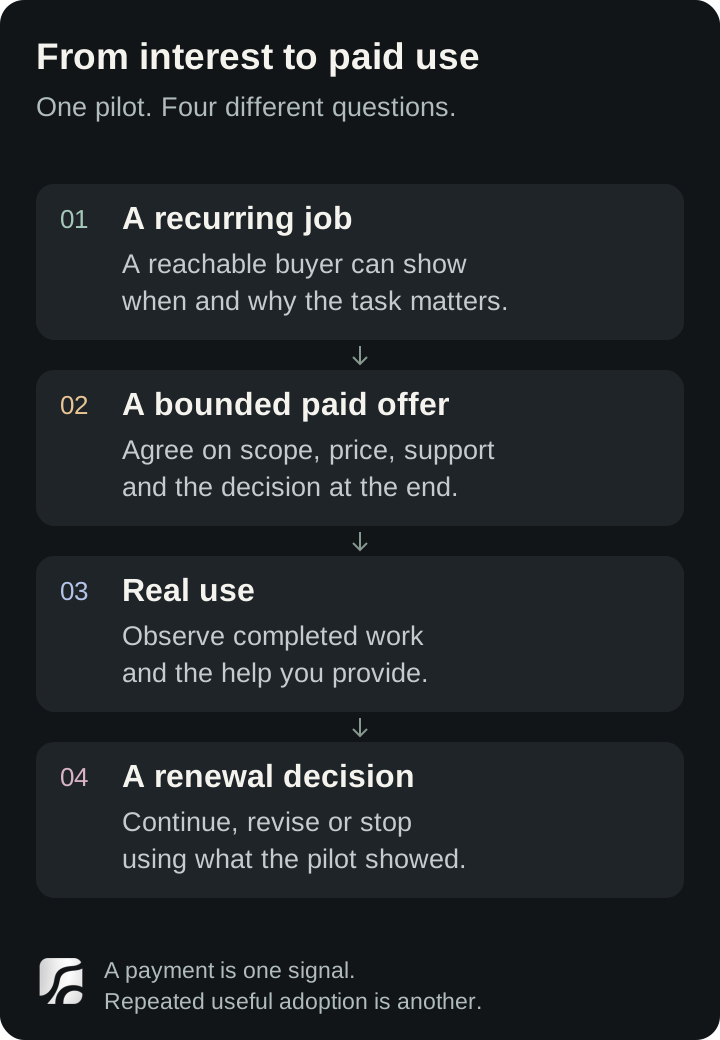
Four different questions: does the job matter, will someone buy, does the service work for them, and is it worth continuing? This is an editorial decision sequence, not a conversion benchmark.
Show one complete job in the demo
For the school example, demonstrate a trial request becoming a confirmed appointment, followed by the coordinator finding the next action. Use synthetic records and the customer's vocabulary. Include the awkward case they mentioned, such as rescheduling, instead of touring every setting in the application.
Be precise about what is already available. If follow-up requires a manual step, show that step. If a calendar connection is only proposed, keep it out of the claim that the service works today. The demo-evaluation workflow is useful from this side of the table too: a complete journey is more informative than a polished feature list.
Ask whether the demonstrated journey addresses the original situation and what would prevent the team from using it. An objection about moving appointments needs a different response from an objection about price. Neither is automatically a request for more features.
Make the pilot a small, complete offer
A paid SaaS pilot should name the work being bought, the people involved, its duration, the price and the decision at the end. It needs enough real use to test the recurring job. A two-week pilot makes little sense for work that happens once a quarter.
Here is a hypothetical offer for a school with trial requests arriving during an upcoming intake. The amounts and limits below are illustrative proposal terms, not recommended market prices or an existing SaaSCode offer.
| Part of the offer | Example scope |
|---|---|
| Buyer and users | One independent school; its owner approves and two coordinators use the service |
| Job | Track adult trial requests, appointment confirmation and the next follow-up action |
| Duration | Four weeks covering the next intake period |
| Pilot price | $180 for the defined pilot, including one setup session and service access |
| Setup limit | Configure one agreed workflow and help enter up to 20 open requests |
| Support | Two scheduled review calls; questions handled on business days |
| Excluded work | Payroll, course delivery, a website redesign and new third-party integrations |
| Continuation | A separate decision at the end; proposed ongoing access at $60/month, with its support scope stated |
| Exit | Agree before starting how the school retrieves its records and what happens to access and stored data |
Before offering anything like this, confirm that your implementation supports the whole job, including the exit. Discuss payment timing, cancellation and any refund terms clearly. The table is a commercial example, not a complete agreement.
Separate temporary setup help from what the monthly service includes. If you personally chase every learner throughout the pilot, the buyer may be evaluating your administrative service rather than the software. That can be a viable offer, but it needs its own price and capacity plan.
Decide what would count as a useful pilot
Agree on observations before starting. For the school, that could mean coordinators completing request-to-confirmation work on several normal working days, finding the follow-up status without asking you, and bringing an exception to a review call with enough context to resolve it.
Do not choose a target such as “increase enrollment by 30%” just because it sounds commercial. Lesson quality, advertising, seasonality and the school's own follow-up affect enrollment. A small pilot may help you examine part of that process without proving a revenue effect.
Record your help as well as the customer's activity. How many tasks required you to intervene? Was each intervention onboarding, a defect, missing functionality or a service you intend to keep providing? The answer determines what the next customer would actually buy.

Fictional AI-generated oil illustration: review completed work alongside the time spent supporting it. The cards and screen are schematic, not customer records or measured results.
The illustrative $180 pilot also has to support your delivery work. If it takes six hours of setup and assistance, that is $30 per delivery hour before hosting, payment fees and other costs. This is simple example arithmetic, not a margin forecast. It helps expose an offer that depends on more personal work than you planned. Use the SaaS launch-cost guide to place that work alongside the rest of your operating budget.
Use the renewal conversation to choose the next move
At the end, return to the job the buyer agreed to test. Review what the team used, what remained outside the system and what assistance was needed. Ask for a concrete continuation decision at the previously discussed price and scope.
| What you observe | A reasonable next move |
|---|---|
| The team uses the workflow and wants to continue with manageable support | Offer ongoing service and test the same offer with another similar buyer |
| The buyer pays, but you do nearly all the work | Decide whether to price a service-assisted offer or simplify delivery before selling more |
| The workflow helps, but a repeated, bounded gap prevents continued use | Scope that gap and agree on a retest; do not promise a broad roadmap |
| People praise the demo but never bring a real task or purchasing decision | Revisit urgency, buyer authority or your choice of audience |
| Success requires replacing several unrelated systems | Stop this pilot scope or choose a more suitable starting product |
Ask for a referral only after the customer has experienced something they can describe. A useful introduction explains who the service helped and with which job. Request permission separately before publishing their name, testimonial or results.
The next sale should test whether the same core offer works again. If every buyer changes the target user, workflow and support promise, you are learning about several businesses at once. Keep those variations visible before investing in a larger campaign.
Let the first sales sharpen your content and product choices
Write down the questions buyers actually ask: how rescheduling works, what switching involves, who owns follow-up, or whether the service fits a second location. Those questions can inform product pages and useful articles. They are evidence of customer questions, not measured search volume.
Content can explain the offer and make a conversation easier. It should not become the condition that delays every attempt to meet a buyer. Likewise, a complementary product makes sense when it solves another observed job for the same audience, not when it merely adds another subscription. The guide to complementary SaaS products distinguishes that opportunity from an integration or an unrelated upsell.
SaaSCode's catalog offers finished SaaS products with source code as a starting point. Compare a candidate's documented workflow with the job your buyer described, then adapt and operate it within its actual capabilities and license. Buying the application does not supply an audience or validate the pilot offer.
Start with one reachable buyer, one recurring job and one offer you can explain clearly. Your first customer gives you a chance to learn what people pay for and what it takes to deliver it. The second comparable customer helps you find out which parts you can repeat.
Editorial collaborations
Something useful to add?
Bring a documented case, an expert perspective or a better source to the SaaSCode blog.
Editorial collaborations