
On this page
Bundle two SaaS products when the same buyer needs both for a recurring job and your combined offer makes that job easier to start, pay for and get help with. Keep separate offers when buyers need the products at different times, already have one of the tools, or would be paying for a second application they rarely use. A relevant referral can be the right relationship when you cannot yet justify a combined commercial promise.
The deciding factor is not how many applications you own. It is whether a specific customer benefits from buying them together. Two good products can make a poor bundle, while two distinct applications can support a useful joint offer without sharing a database.
For a SaaSCode operator, the starting point is finished software you can deploy and adapt within its licence. The decision here concerns the customer-facing services you operate with that software. It is separate from buying source code, and it does not grant permission to redistribute the source in a package.
Start with one buyer who needs two outcomes
Imagine a small agency that receives client requests through a form and manages accepted work on a task board. Its owner wants fewer missing briefs and clearer delivery responsibilities. That gives us two related jobs: collect a usable request, then organize the work the team has agreed to do.
Those jobs connect, but the customer's situation still matters. One agency may already have an effective task system and need only better intake. Another may manage work well but receive too few structured requests to justify a dedicated forms service. A third may be replacing both systems at once.
The third agency is a more plausible buyer for a combined offer. Treating all three as the same audience would hide the reasons some customers prefer separate subscriptions.
There are real product categories behind this fictional example. Formlet is described as a form and survey builder with publishing, responses and export. Taskline is described as team project management with board, list and calendar views. They are candidates for the intake and delivery jobs, respectively. Their public descriptions establish those separate roles; they do not establish a native connection between them or an existing SaaSCode bundle.
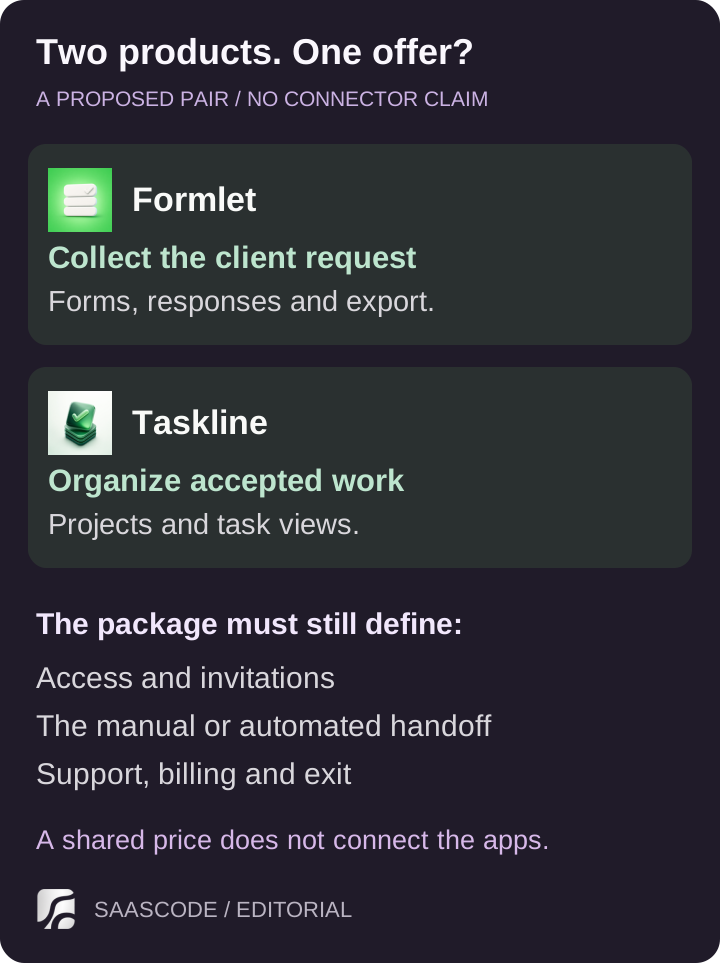
An editorial pairing to investigate, using the products' real catalog icons. Two applications included in an offer do not automatically share accounts, billing or data. This is not an announced bundle or tested integration.
Our guide to choosing complementary products helps identify the adjacent job. Once that relationship is clear, the next question is narrower: does one commercial offer serve this buyer better than two?
A bundle changes the promise, even before you connect anything
A bundle means the customer buys an explicitly defined combination. It might include access to two applications, coordinated onboarding and one support entry point. It does not have to mean one interface. What matters is that the offer describes the experience accurately.
For the fictional agency, an honest first version could include a forms workspace, a work-management workspace and a short setup session that helps the team use both. If staff manually transfer accepted requests, say so. Do not advertise automatic task creation until that path exists and has been checked.
Separate logins can be acceptable for a disclosed package. They become a problem when a sales page implies a unified workspace. The same is true of separate user invitations, usage limits and data exports. A customer should not discover those boundaries only after paying.
An established suite illustrates the broader promise. Zoho One presents multiple applications alongside centralized administration and one invoice. That is a provider's documented offering, not evidence that any two applications you combine already have those capabilities. Use the example to identify which promises require implementation in your own offer.
If customers need a record to move between applications, follow the connection guide. A commercial bundle and a reliable technical handoff are separate pieces of work. You can test demand for the former without pretending to have finished the latter.
Choose between a bundle, separate offers and a referral
The choice becomes easier when you compare the reason for buying, not the amount of software in the package.
| What you learn about the buyer | Offer worth trying | Why it fits |
|---|---|---|
| The same person needs both jobs now and can approve the purchase | A defined bundle, possibly alongside standalone options | One purchase may reduce coordination for a complete job. |
| The second job becomes relevant only after the first is established | Separate offers with an optional later upgrade | The customer can adopt at a useful pace. |
| Most buyers already have a satisfactory second application | Standalone access with a contextual referral | Avoid charging them for a replacement they do not want. |
| Different departments control budget, access or procurement | Separate offers with a clear relationship | Shared company ownership does not make them one buying decision. |
| Buyers repeatedly need a cross-application handoff | Evaluate the connection and the commercial offer together | A discount alone will not remove manual coordination. |
An optional bundle can preserve a useful choice: buy either product separately or buy the combination. That does not prove the bundle will sell. It simply gives you a way to distinguish customers who value the combined job from customers who want one component.
A referral makes a smaller promise. It points the customer to a relevant service at the moment of need, with any commercial relationship disclosed. If the recipient buys elsewhere, account creation and support may remain separate. Describe those facts rather than calling the recommendation an integrated solution.
For our agency example, a link shown after a request has been accepted could introduce a work-management option. An agency already using a task tool should be able to ignore that suggestion without losing the value of the forms service.
Compare each buyer with what they would otherwise buy
A bundle price can increase revenue from one customer and reduce it from another. The useful comparison is the customer's plausible alternative, not just the combined list price.
Here is an invented monthly example in US dollars. These are not SaaSCode catalog prices, provider quotes or measured customer costs. The two services are operated by a fictional business. Direct costs include the variable service and support costs assigned to that customer; the bundle adds an assumed coordination cost.
| Monthly offer | Customer price | Assumed direct costs | Contribution before fixed costs |
|---|---|---|---|
| Intake alone | $39 | $10 | $29 |
| Work alone | $59 | $20 | $39 |
| Both purchased separately | $98 | $30 | $68 |
| Combined package | $89 | $35 | $54 |
The combined package gives a customer who would buy both a $9 monthly price reduction. It also adds $5 of assumed coordination cost for the operator. Moving that customer from two separate purchases into the bundle therefore reduces monthly contribution by $14, from $68 to $54.
Now consider an intake-only customer who would otherwise remain on the $39 offer. If that customer adopts the $89 package, the assumed contribution rises from $29 to $54: $25 more per month. The price increase is $50, but the additional direct costs consume half of it. Revenue growth and contribution growth are different numbers.
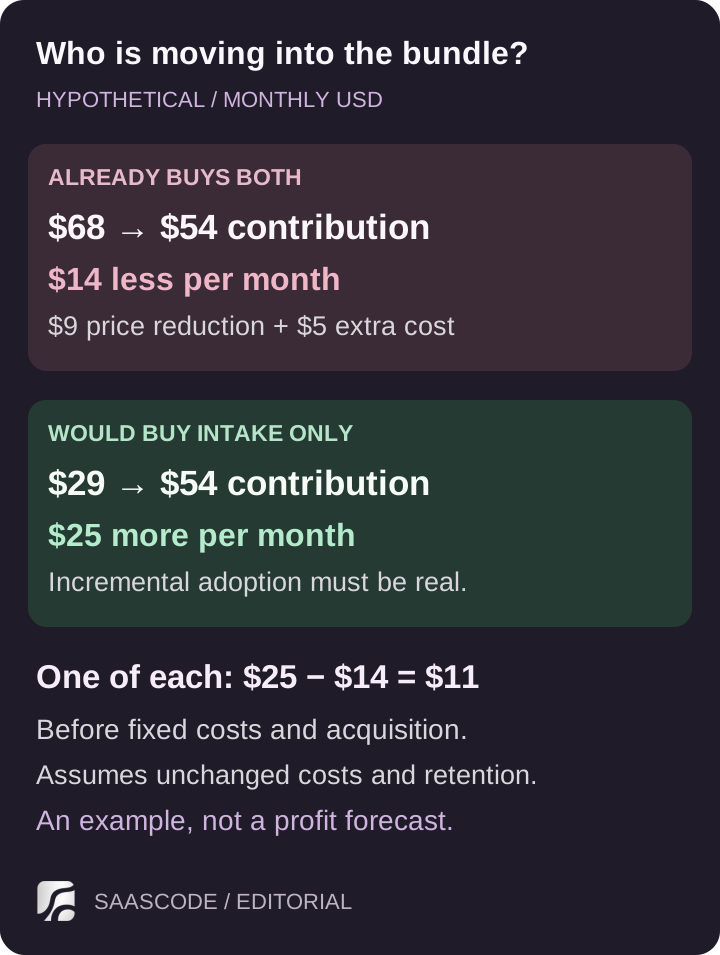
Illustrative arithmetic, not a forecast. The same package has different effects depending on what the customer would have bought without it.
Under these assumptions, one additional intake-only upgrade more than offsets one existing dual-product buyer moving to the lower-priced bundle: $25 gained minus $14 lost leaves $11. That is a narrow contribution comparison, not a claim of profitability. It excludes fixed operating costs, acquisition, setup, taxes and any change in retention. It also assumes both buyers remain active for the same period and costs behave as stated.
For a larger example, ten existing dual-product customers moving to the bundle would reduce monthly contribution by $140. Six truly incremental intake-only upgrades would add $150, leaving $10. If those six customers would have bought the second service anyway, treating their upgrades as incremental would overstate the benefit. The counterfactual matters.
Actual support demand may rise in steps rather than smoothly. One more package could require an extra support shift, a higher infrastructure tier or a new integration-maintenance commitment. Replace the assumed costs with observed delivery work before widening the offer. The SaaS launch cost guide covers the broader operating budget that this small comparison deliberately leaves out.
Decide what happens when the customer uses only half
The sale is only the start of the package. A customer may activate intake immediately and postpone the task system, invite different colleagues into each app, or stop needing one of them later. Those are ordinary product states that deserve an answer before promotion.
For the agency example, define a useful first outcome for each part. The forms side might reach its first complete client request. The work side might reach its first accepted task assigned to someone responsible for delivery. Those are proposed activation signals for this example, not universal definitions of product success.
If the agency completes the first outcome but never reaches the second, find out why. The explanation could be missing setup help, a second tool already in place, a weak fit or a timing issue. Including access in the price does not establish that the second application created value.
Explain the exit too. Can the customer move to intake alone at the next renewal? What happens to work records, exports and team access? Which support team handles a complaint that crosses the two applications? Write the intended policy in plain language and implement it consistently before selling that promise.
The software supplier's licence and your customer subscription are different agreements. SaaSCode's current terms permit operating and adapting products within the applicable licence and prohibit distributing the source code itself, including in a bundle. An offer of access to services you operate must not become a package of source downloads for your end users. Check the applicable licence for each product and deployment arrangement.
Run a small commercial trial with a specific learning goal
Begin with a defined audience and a bounded offer. For example, you might propose the combined service to agencies currently replacing both intake and work tracking, while keeping the standalone intake option available. State the separate applications, the current handoff, included setup and support boundaries in the offer they review.
Keep the observation period tied to the customer's work cycle. A business that receives new project briefs every week can show different behavior from one that starts a project every quarter. A short trial that never includes the second job cannot tell you whether the second application is useful.
During the trial, record which alternative each buyer considered, which parts they activated, whether they completed the joint job, and how much support the package required. Customer explanations are evidence about their stated reasons; they are not perfect proof of what they would have done under a different price.
A small trial can expose confusing access, unwanted components and expensive setup. It cannot reliably establish a universal conversion lift or long-term retention benefit. Keep those claims out of the marketing until you have evidence that supports them.
If human setup becomes the main source of value, price and scope it deliberately. Our SaaS plus service guide separates ongoing software access from finite onboarding and recurring expertise. Hiding unlimited implementation inside a discounted two-app package creates a different business from the one in the pricing table.
The first-customer guide offers a related approach to a bounded paid pilot. Here, the specific learning goal is whether buying the pair helps this audience complete a job that neither standalone offer serves as well.
Keep the smallest offer that earns its place
A bundle earns its place when buyers need the combination, understand what is included and can reach a useful outcome without unexpected coordination. A standalone offer earns its place when customers need one job done well. A referral earns its place when the adjacent need is real but a joint purchase would add little value.
For the agency example, start with the buyer's current tools and timing. Investigate the two products' documented scope, make the manual or automated handoff explicit, and compare the package with what the customer would otherwise buy. Then use actual adoption and support work to decide whether the offer should expand.
You do not need to combine every product you operate. A clear reason for two services to be bought together is more useful than a growing list of applications under one price.
Product descriptions and cited terms checked September 30, 2026. The agency offer, prices, costs and outcomes are illustrative proposals, not an available SaaSCode bundle or a measured customer case.
Editorial collaborations
Something useful to add?
Bring a documented case, an expert perspective or a better source to the SaaSCode blog.
Editorial collaborations