

On this page
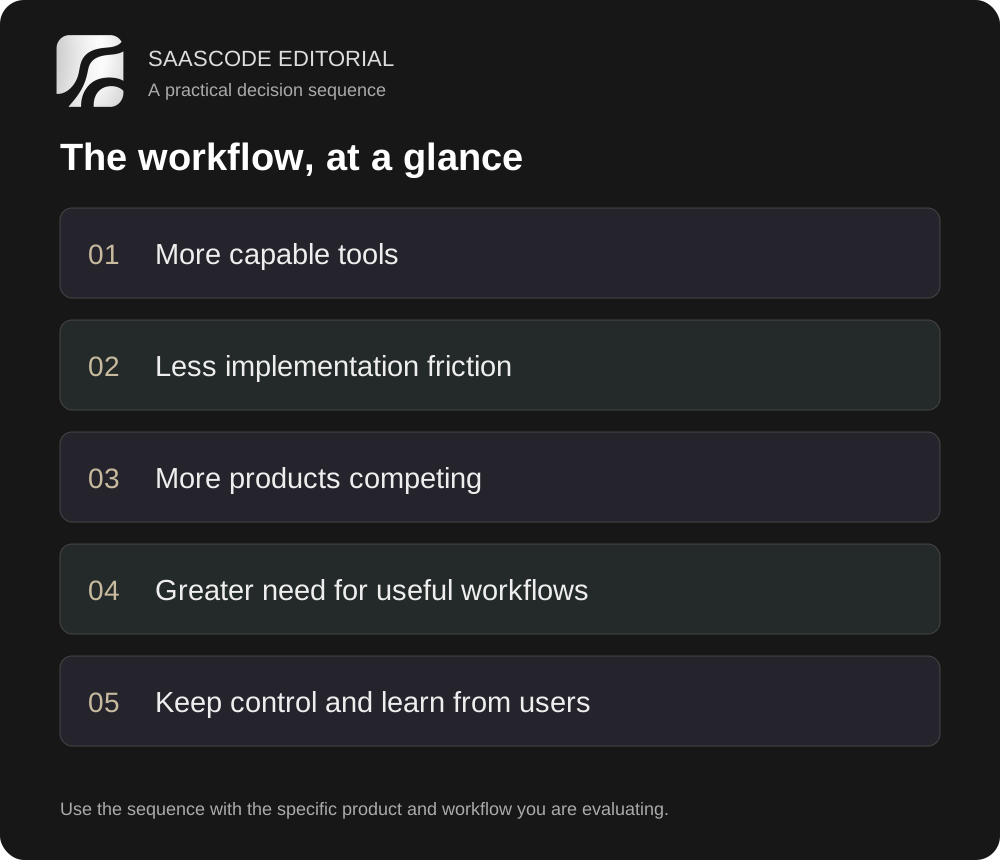
If AI becomes much more capable at writing and changing software, SaaS founders will gain new options. The useful question is which business decisions become easier and which still require understanding customers, coordinating work and accepting responsibility.
This is an opinion piece built around conditional scenarios. It does not assert that AGI has arrived, predict a delivery date or describe SaaSCode as an AGI system.
Define the term before building a strategy around it
Different organizations use AGI in different ways. OpenAI’s charter describes its intended meaning in terms of highly autonomous systems outperforming humans at most economically valuable work. That definition belongs to OpenAI; it is not a certification that any current product meets it.
For a founder, it can be more useful to ask narrower questions. What if implementation becomes cheaper? What if agents can handle longer changes reliably? What if integrating services requires less manual work? Each scenario suggests decisions you can investigate today without needing agreement on the larger label.

Inspect the details that determine the result. Editorial oil illustration.
Scenario one: implementation becomes less scarce
If more people can create working software, simply possessing code may become less differentiating. A product still needs a reason for a particular customer to choose it.
That reason may be a well-understood workflow, a useful distribution channel, a dependable operating experience or a relationship with an audience. More coding capacity can help you improve those things, but it does not tell you which problem matters.
Starting from a finished SaaS could remain useful because it gives you an implemented workflow to inspect and change. Building from scratch could become attractive in other situations. Compare the work remaining in each starting point, rather than assuming one answer applies to every future project.
Scenario two: customization becomes more practical
A developer who understands an application may be able to test more small variations. That could make niche adaptation more accessible: an extra approval step, a domain-specific field or a useful connection to another service.
The constraint moves toward choosing and validating the changes. A team can accumulate complexity faster when creating features is easy. Keep a clear account of what users need and what each addition costs to maintain.
Our AI customization guide focuses on bounded changes for this reason. Its discipline remains useful even if the tools become more capable.
Scenario three: separate products work together more easily
More capable tooling could reduce some of the effort required to connect applications. It would not automatically align their permissions, billing, customer expectations or data definitions.
Two products serving the same audience may first benefit from a helpful referral. A deeper integration becomes worthwhile when users repeatedly need a specific handoff. Our complementary-product guide distinguishes those relationships.
A founder should be able to explain what information moves, who authorizes it and what happens when the transfer fails. Those are product decisions as well as implementation details.
What remains valuable across these scenarios?
Access to source can preserve options for adaptation. Clear documentation helps a person or an agent understand the system. Exportable data and explicit service boundaries can make a future move easier. None of these properties should be assumed from an “AI-ready” label; inspect the product.
An audience with a recurring need is also valuable. So is an operating record: knowing which requests create support work, which actions fail and which improvements customers return to use.

Follow the work through to an observable outcome. Editorial oil illustration.
How does SaaSCode fit an AI-first future?
The practical SaaSCode proposition is to start with a built application, then configure, operate or extend it. AI participates in the development approach; the customer evaluates the resulting software.
For an operator, that can mean launching the documented workflow with the necessary setup. For a developer, it can mean using source as a foundation for a private variant. The AI SaaS factory article explains those paths without assuming that every product embeds the latest model.
A decision you can make now
Select a real workflow, observe its users and test one improvement. Keep control of your changes and document what you learn. If tools improve, that knowledge makes them easier to apply.
You do not need a confident AGI forecast to choose software you can understand and adapt. You need a useful problem, a credible starting point and a way to keep checking that the business serves its users.
Editorial collaborations
Something useful to add?
Bring a documented case, an expert perspective or a better source to the SaaSCode blog.
Editorial collaborations