

On this page
An AI SaaS factory uses AI as part of a repeatable process for producing software products. For a buyer, the useful question is what that process delivers: an application with a defined job, working user journeys, source access where offered, and a clear path into operation.
SaaSCode uses the term for its production model and sells finished catalog applications with source included. The public catalog is where you can inspect those products. The fact that AI helped build an application does not, by itself, tell you whether the application needs AI to run, fits your business, or includes managed hosting.
Those distinctions are where a useful evaluation begins.
Separate the method, the product and the service
Three different things can be described with similar language.
The method explains how software is made. AI assistance can be part of development without becoming a feature your customers use.
The product is the application a buyer receives or accesses. Its value depends on whether its screens, permissions, data and workflows support the intended job.
The service agreement determines who installs, hosts, maintains or changes that product. Those responsibilities do not follow automatically from the word “factory.”
For example, an AI-built job board might use ordinary search at runtime. An application built conventionally might call an AI model whenever a customer submits a request. The first can have no per-search model cost; the second needs an operating budget and failure behavior for its model integration. Inspect the product rather than inferring runtime behavior from its origin.
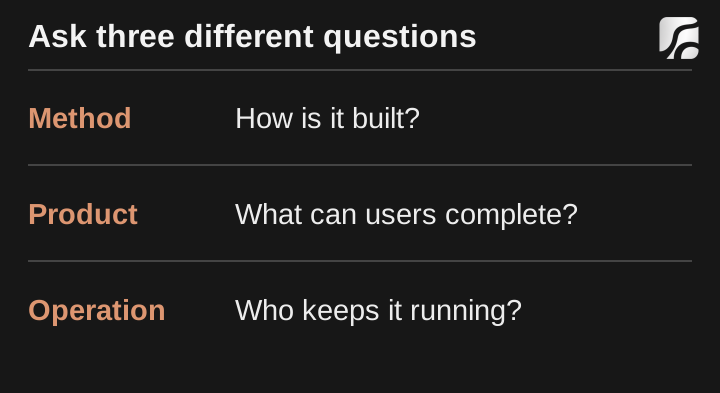
The production method explains origin. Product evidence explains capability. The operating agreement explains responsibility.
The category label needs an explicit definition in each offer: it can describe a production process, a development framework, or a service that builds applications. It does not specify a standard set of delivered features. Start with one concrete application in the product catalog and its public evidence. In particular, using AI during production does not establish that the delivered application contains a customer-facing AI feature.
What a buyer should expect to understand
A useful delivery lets you describe a specific exchange of value. Who enters the application? What do they create or receive? Who pays? What can the operator control? What happens when the main task cannot be completed?
A long feature inventory helps with discovery, but related features must connect. “Accounts, billing and dashboard” does not explain whether a paid account receives the right access, whether cancellation changes that access, or whether the owner can resolve a support problem.
Read the product description as a set of connected promises. Then ask for the evidence that is appropriate to each promise:
| Promise | Evidence to look for | Question it answers |
|---|---|---|
| It performs a business workflow | A demo of the relevant user journey | Can the intended people complete the task? |
| You can run the delivered product | Versioned source and installation instructions | What must your operator set up? |
| Different users have different powers | Documented roles and suitable verification | Who can see or change which records? |
| The package has a known scope | Included features, limitations and release information | Which assumptions would require extra work? |
| Problems have a route to resolution | Support terms and a contact path | Who owns the next action? |
| You can keep developing it | Source access, license and dependency information | What changes are allowed and practical? |
This is an evaluation framework, not a claim that one screenshot proves every row.
Repeatability matters when it survives delivery
The value of a repeatable production process is that the buyer can receive a coherent starting point. Shared patterns can make familiar operations easier to understand across products. That value is only useful when the particular product still implements the right rules for its users.
A booking system and a job board might both need accounts, payments and email. They should not therefore have identical business behavior. A booking must account for availability; a job board must account for publication and applications. Evaluate the transitions that make the product specific.
On SaaSCode, Fabric explains common platform capabilities. Product records and Builds provide product-specific context. Read those surfaces together: the common foundation explains part of the package, while the individual product establishes the job it is meant to do.

The operator gives a delivered product a business context — an editorial oil illustration.
Read technical evidence with its limits intact
A release identifier tells you which artifact is being discussed. A test result describes the checks that ran on that artifact. A demo shows behavior in a particular environment. None of these alone establishes suitability for every future deployment.
For a material requirement, ask four questions:
- What exactly was checked?
- Which product version and environment were checked?
- What result was observed?
- What remains outside that check?
A report about application access controls, for instance, should not be turned into a guarantee that a customized deployment is secure. The configuration and changes you introduce also matter.
The NIST Secure Software Development Framework provides shared language for producers and buyers discussing software security practices, including protection, development and vulnerability response. It is a useful source of questions for a technical reviewer. Merely mentioning it does not certify a vendor or a product.
Keep the purchasing decision proportional to your use. A small internal workflow and a service handling sensitive customer data can justify very different levels of independent review.
Source access changes the handoff
With a source-included product, you can inspect and modify the delivered application within its license. You also need the skills or delivery partner to manage the installation and subsequent changes.
For SaaSCode catalog products, the current terms distinguish the product purchase from hosting and ongoing operation. The buyer runs the product on their own infrastructure. Source access permits building and operating a business with the software; it does not grant permission to redistribute the underlying code.
Do not assume an optional membership changes those rights. SaaSCode's Plus page describes member-only purchase access, continuing human support and Genesis over MCP. It treats Client licensing and custom development separately.
A practical handoff therefore includes two lists: what is delivered and what your operator must connect. If you cannot identify the person responsible for domains, databases, payment accounts, backups and updates, settle that before planning a launch date.

A production method is not proof of an outcome — an editorial oil illustration.
Choose the purchase that matches the work
Start with the catalog when an existing application's central workflow fits. You can evaluate an actual product, read its boundaries and decide whether the remaining configuration or modification is reasonable.
A boilerplate fits a different job: your team wants to build the distinctive workflow and needs a foundation. It should be judged by how well it supports that development work.
A custom engagement becomes relevant when your essential requirement changes the central workflow, data model or service boundary. SaaSCode's Hire the Factory is its public route for discussing work beyond an existing catalog product. A specific scope and written agreement determine what that engagement covers.
For an example, suppose a buyer needs a moderated job board. They can begin with a product designed for employer postings and candidate applications. If they instead require staffing placements, employment contracts and payroll, changing the heading to “staffing platform” will not supply the missing business system. The important gap is visible before anyone debates the generation method.
Make the next step concrete
Choose one product and write a short acceptance statement: “A person in role A can complete action B, and role C can see result D.” Add the one failure case that matters most to your business. Then inspect the demo, documentation and delivery terms against that statement.
Use the SaaS demo evaluation workflow for a worked approach. If the product fits, move to the launch sequence and assign operating responsibilities.
An AI SaaS factory is useful to you when its output reduces the work between a defined business need and a product you can operate. The evidence for that is in the delivered application and its handoff.
What does AI-first mean for SaaSCode?
SaaSCode builds complete SaaS products with AI. The practical starting point is a delivered application that you can configure, customize and operate within its documented scope. AI-first describes the development approach; a model used to build software and an AI feature inside that software are separate things. Check the specific product before assuming it includes a chatbot, a model subscription or an interchangeable provider connection.
An operator can launch the existing workflow after the required setup. A developer can use the source as a foundation for a focused private variant. Our AI customization guide describes that second path, with separate guides to GPT-6 Astra and Claude Fable 5.1. Those are documentation-based workflows, not invented performance comparisons.
More capable AI also raises broader questions about the future of SaaS. The useful decision today is which product gives your business a credible starting workflow and enough control to evolve it.
Editorial collaborations
Something useful to add?
Bring a documented case, an expert perspective or a better source to the SaaSCode blog.
Editorial collaborations