

On this page
GPT-6 Astra is relevant to a SaaS developer when it helps complete a concrete change in an existing application. The practical question is how to give it enough context, choose an appropriate task and verify what it produces. The name of the model cannot answer those questions for you.
This guide refers specifically to OpenAI’s GPT-6 Astra, using its official model documentation, checked on September 12, 2026. It is a documentation-based workflow. We are not reporting a measured Astra benchmark, a completion-time comparison or a verified deployment performed by that model.
The launch context
OpenAI’s Astra announcement emphasizes coding, computer use and long-running professional tasks. Those are the provider’s reported capabilities. For a source-code buyer, the practical opportunity to evaluate is whether the model can understand an existing application, make a bounded change and help verify its behavior. Our cover takes its star-field reference from the launch artwork; the numeral six and observatory are our own editorial composition.
Choose a task that exposes useful reasoning
A sensible first task is a small behavior change with more than one constraint. For example, add a topic filter to an editorial index while preserving article links, keyboard access and the empty state. Another is to map an accepted intake record to one task while rejecting duplicates.
These tasks are more revealing than asking for a new landing page. The agent has to understand existing data, state and failure conditions. You can also decide whether the result works without relying on subjective impressions.
If you have not yet selected your starting product, use our finished SaaS versus boilerplate comparison. Starting with a product that already handles your main workflow can reduce the amount of behavior you need to invent. It does not remove the need to review a modification.

Original launch artwork: OpenAI. Shown as source material; the cover above is our editorial interpretation.
Separate the model from the coding environment
A model, a coding client and the tools available inside that client are different parts of the workflow. File access, terminal execution, browser testing and permission controls depend on the environment you actually use.
Record the selected model identifier, client, date and enabled tools when you run your own case. A result produced with repository access and test execution is not comparable to an answer produced from a short pasted prompt. Avoid attributing an environment’s capabilities to every use of the model.
The OpenAI model guide is the right place to check current configuration guidance. Keep version-specific settings in your execution notes rather than assuming that a remembered default still applies.
Write an acceptance brief the developer can reuse
A useful brief has five parts: current behavior, desired behavior, preserved behavior, allowed scope and evidence. For an intake adapter, the desired result might be one destination task per accepted source event. Preserved behavior includes workspace isolation and no mutation for invalid input.
Add concrete examples. One valid event should create a task. Repeating its identifier in the same workspace should reuse the result. An event for another workspace should fail before the destination is called. A temporary destination failure should leave the event retryable.
The same brief can be used by a human developer or another model. That makes the work reviewable and reduces the chance that an attractive explanation substitutes for a correct result.
Ask for a trace before a patch
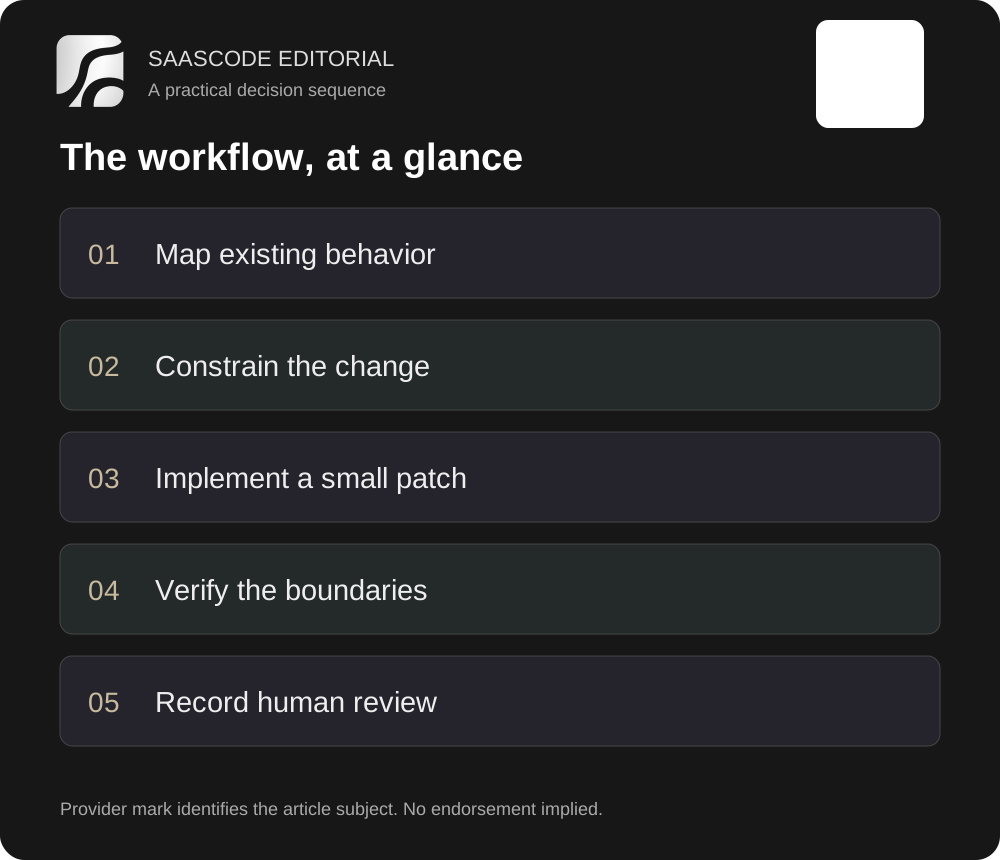
Have the agent locate the existing input boundary, validation and side effect. Ask it to explain which assumptions come from code and which remain unverified. Then constrain the patch to the smallest surface that can satisfy the acceptance examples.
This step often reveals that the apparent feature is actually several features. Shared login, billing synchronization and a task handoff are separate projects. If your immediate need is the handoff, finish that first.
In the customization workflow, we use this approach to keep the change tied to observable behavior. The example adapter is a local synthetic exercise. It establishes a testing pattern without claiming that catalog products are already connected.

Follow the work through to an observable outcome. Editorial oil illustration.
Measure the outcome you actually care about
Record whether the original workflow still works, whether the new examples pass and how much human correction was required. If you measure time, state what the clock includes. If you report cost, use the actual run receipt and distinguish subscription access from metered API usage.
Do not turn a successful task into a claim that the model can operate the whole business. Customer support, release decisions and recovery remain responsibilities someone must own.
What should a SaaSCode developer do next?
Select a product whose documented workflow is already close to the business you want to run. Identify one valuable difference, inspect its source and execute a bounded local change. Keep the original baseline and a readable change record.
Then plan how the private fork will receive updates. A customization has more value when the next developer can understand it. Model capability is useful; a maintainable result is the asset you keep.
Editorial collaborations
Something useful to add?
Bring a documented case, an expert perspective or a better source to the SaaSCode blog.
Editorial collaborations