

On this page
Choose a finished SaaS application when its core workflow already fits your business. Choose a boilerplate when you need reusable infrastructure but intend to design and implement the domain workflow yourself. Choose custom development when the requirements justify building around your process from the beginning.
The distinction is the work remaining before a real customer can complete the job. Repository size, the number of features on a landing page, and an attractive purchase price are poor substitutes for that comparison.
This guide compares categories by explicit criteria. It is not a vendor ranking, a benchmark of build speed, or a claim that one route always costs less. Individual offers vary, and custom projects can themselves start from reusable foundations.
Three starting points, three different commitments
A finished application sold with source implements a particular kind of product. You evaluate the delivered workflows, then configure and adapt the application for your business. Finished describes the offered product's scope; your deployment and business preparation still require work.
A boilerplate provides a reusable starting point. Depending on the package, it may include authentication, billing, layouts, or other common infrastructure. Its main value is work you can reuse while building the domain behavior that makes your service useful. Inspect what a specific package actually implements.
A custom build begins with an agreed problem and delivery scope. The team selects or creates the implementation around that brief. You need decisions about acceptance, responsibility, rights, changes, and maintenance alongside the code.
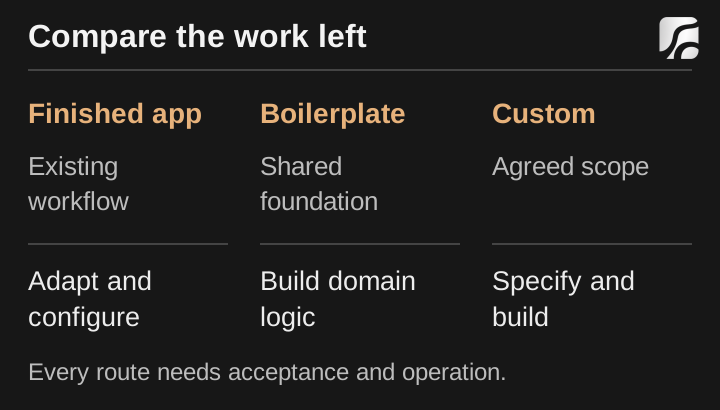
Editorial diagram: each route starts at a different point, and each eventually needs an operator.
| Decision criterion | Finished application with source | Boilerplate | Custom build |
|---|---|---|---|
| Starting point | Existing product workflow | Shared application foundation | Agreed requirements and chosen foundation |
| Main work before launch | Validate fit, configure, adapt, test deployment | Design and build domain behavior, then configure and test | Specify, implement, review, and accept the agreed scope |
| Strongest fit | Your central job resembles the delivered product | Your team wants to build a differentiated workflow | Essential requirements do not fit existing products |
| Main uncertainty | How deeply adaptations affect the existing system | How much domain work remains | Whether scope and acceptance are clear enough to deliver |
| What to inspect | Demo, product docs, license, releases | Implemented modules, documentation, license | Scope, milestones, exclusions, rights, handover |
| Ongoing responsibility | Your operation and your modifications | Your application and its operation | Whoever the delivery and maintenance agreements assign |
For a concrete foundation example, the Next.js SaaS Starter documents authentication, Stripe payments, and a dashboard. Those are useful shared capabilities. They do not by themselves specify a recruiting journey with employers, candidates, and an operator. Compare that starting point with the domain workflow described on Vacanta’s product page, then list the work your scenario still needs. This is a comparison of documented starting points, not a benchmark of either implementation.
Start with one customer journey
Write down a task a customer must complete, including the awkward part. A hypothetical equipment-rental service might need a customer to reserve an item, an employee to confirm availability, and a manager to handle a late return. The last step may determine the choice more than the booking screen.
Now ask each option to demonstrate or explain that journey. Does the workflow exist? Can its rules be configured? Will you need a new entity, approval state, permission, or integration?
A finished booking application may be a strong base if its inventory and reservation model support the business. If it assumes one appointment per person while you need pooled equipment quantities and damage deposits, the required work could reach into several parts of the application. Describe those changes before comparing prices.
A boilerplate may already solve sign-in and account billing while leaving the rental model entirely to you. That can be a good trade when your team has the capability and wants to control the design. You are buying or adopting a foundation with that intention.
A custom engagement can address unusual allocation or approval rules directly, provided they are in the agreed scope. The word custom does not make an unstated requirement part of the contract.
Custom work begins with a particular requirement — an editorial oil illustration.
Separate configuration from product changes
Use two columns during your review. In the first, list changes supported by documented settings: brand assets, email sender, offered plans, or other configurable behavior. In the second, list changes that require implementation.
Then trace each implementation change through the customer journey. A new field may be small if it only appears on one form. It becomes broader if it affects permissions, imports, exports, filtering, notifications, and historical records.
This is also where a source purchase provides a useful option: you can adapt the application within its license. That control has value when a change is important enough to maintain. It does not make all changes equally inexpensive.
For SaaSCode, inspect the catalog product that matches your need and its public Inside record. The catalog offers finished applications with source included. Hire the Factory is the separate public route for discussing custom work. Neither route turns a list of desired features into an agreed scope automatically.
Compare the work, then the money
Ask for the same breakdown across all three options:
- Acquisition: product license, foundation license, or development agreement.
- Implementation: configuration, domain work, integrations, and changes.
- Acceptance: testing the customer journey and reviewing the deployment.
- Operation: hosting, services, support, maintenance, and recovery.
- Future changes: who handles them and how they will be priced or staffed.
For a self-built route, include your own hours even if no invoice changes hands. For a fixed-scope custom quote, record exclusions and the change process. For a source-code purchase, identify which adaptations you can make and which need help.
There is no useful universal price ladder here. A close-fitting finished application can remove substantial domain work. A finished application that needs its core model replaced can lose that advantage. A boilerplate can be economical for a capable team and expensive for someone who must hire every missing step. Use the cost planning guide to compare explicit assumptions.
The remaining work changes with the starting point — an editorial oil illustration.
Control includes responsibility
All three routes need a maintenance owner. Even when deployment is included in a custom engagement, confirm what happens after handover. Are updates part of the agreement? Who investigates a failed integration? Who holds provider accounts and can restore data?
Technical acceptance also extends beyond a passing build. The Next.js production checklist separates development choices, security, performance, and checks before going to production. It is one framework-specific reminder that working code and an operated service involve more than compilation. Apply the guidance for the actual stack you select.
Read rights with the same care. A source-code license, an open-source license, and a custom-development agreement can grant different permissions. In SaaSCode's case, the product terms permit licensed operation and modification while restricting source redistribution. Plus is a separate membership and does not grant client rights; its current page explains the distinction.
A decision you can explain in one paragraph
Finish your comparison by completing this statement:
Our customer needs to complete ___. This option already covers ___. We still need to build or configure ___. The owner of that work is ___. Our main unresolved assumption is ___.
If the missing section is mostly configuration and a few bounded adaptations, review a finished application first. If your differentiator is a workflow you intend to build and your team can implement it, evaluate a boilerplate. If essential requirements reach across the product and need a delivery team, prepare a custom brief.
Keep a hosted subscription in consideration when the real need is to use software and leave its operation with a vendor. That is a different purchase with a different responsibility split.
To evaluate the finished-application route, browse the SaaSCode catalog with your customer journey in hand. For a requirement that needs its own brief, describe it to Hire the Factory. In either case, make the work left visible before you choose.
If AI can write the code, why start from a finished SaaS?
An AI tool can help implement each of these starting points. The comparison still depends on what has already been decided and tested. A finished product can supply a domain workflow, roles and data relationships that a developer would otherwise need to design. A prototype can be better for exploring a new interaction. Custom work can be appropriate when the important requirements diverge substantially from existing products.
Compare the remaining work in one scenario rather than counting generated files. Our guide to moving from an AI prototype to an operating SaaS follows the workflow, permissions and recovery questions. If the product already fits most of the need, a bounded AI-assisted customization may be a practical next step.
Editorial collaborations
Something useful to add?
Bring a documented case, an expert perspective or a better source to the SaaSCode blog.
Editorial collaborations