

On this page
An AI-generated prototype can make an idea tangible. You can show a screen, test a sequence and learn whether the proposed interaction makes sense. An operating SaaS has a larger job: it must keep working for different users, with real records, failures and ongoing support.
The gap is easiest to understand through one business workflow. Consider a niche job board. A prototype may show a listing and an application form. The business needs an employer to manage a listing, a candidate to submit an application and an operator to handle the resulting work. It also needs rules about who can see and change each record.
Compare starting points by the work they leave
A finished product, a boilerplate and a generated prototype can all be useful. Their usefulness depends on which decisions have already been implemented and which remain yours.
A boilerplate may provide shared technical foundations. A prototype may explore your specific idea. A finished application may already implement a domain workflow you can configure or extend. Inspect the actual artifact rather than relying on its category label. Our comparison of the three starting points makes that decision more explicit.

Inspect the details that determine the result. Editorial oil illustration.
Follow one record from beginning to end
Create a representative record and follow it across roles. For a hiring example, ask what happens after an application is submitted. Can the correct employer review it? Can the candidate see the appropriate status? What can the operator correct?
The public Vacanta product page is a concrete starting point for investigating a niche job-board product. Its published scope is evidence about that product, not evidence that every job board or every generated application includes the same behavior.
Use a demo to observe the workflow, and the delivery documentation to understand how it is installed and operated. Write down where a feature is documented, where you observed it and where you still need an answer.
Check the invisible parts of the experience
A screen can look complete while its permission model is incomplete. An email button can appear to succeed while no delivery service is configured. A payment flow can look plausible without its failure and reconciliation behavior being exercised.
| Surface | Prototype question | Operating question |
|---|---|---|
| Data | Can the form save? | Can records be corrected, exported and recovered? |
| Roles | Does each screen exist? | Is access enforced when a request is made directly? |
| External services | Is the happy path visible? | What happens when the service fails or responds twice? |
| Deployment | Does it start locally? | Can the operator configure, monitor and recover it? |
| Support | Is there a contact link? | Who owns incidents and customer questions? |
The OWASP verification standard provides a primary reference for application-security verification. Selecting checks from it is part of an engineering process; mentioning it does not certify a product.
Decide whether to finish or replace the prototype
Keep the prototype when its domain model is useful, its implementation is understandable and completing the missing work fits your resources. Consider another starting product when most of the core workflow still needs to be built and a documented application already fits it.
There is also a middle path: keep what you learned about the audience and apply it to an existing product. The prototype becomes a specification aid rather than the production foundation. That can preserve the valuable discovery without preserving every early implementation choice.

Follow the work through to an observable outcome. Editorial oil illustration.
Where SaaSCode fits
SaaSCode’s AI-first position concerns how software is created and evolved. For a buyer, the practical artifact is the delivered product and its source. The intended starting point is a complete application within its documented scope, ready for configuration, customization and operation.
That does not mean every product includes every model as a runtime feature. It also does not make external accounts, hosting or domain configuration disappear. Our AI SaaS factory guide separates the production approach from the responsibilities of the operator.
A developer can use that source as the foundation for a private customization. An operator can start with the existing workflow. Both should evaluate the same concrete evidence.
Make the next decision observable
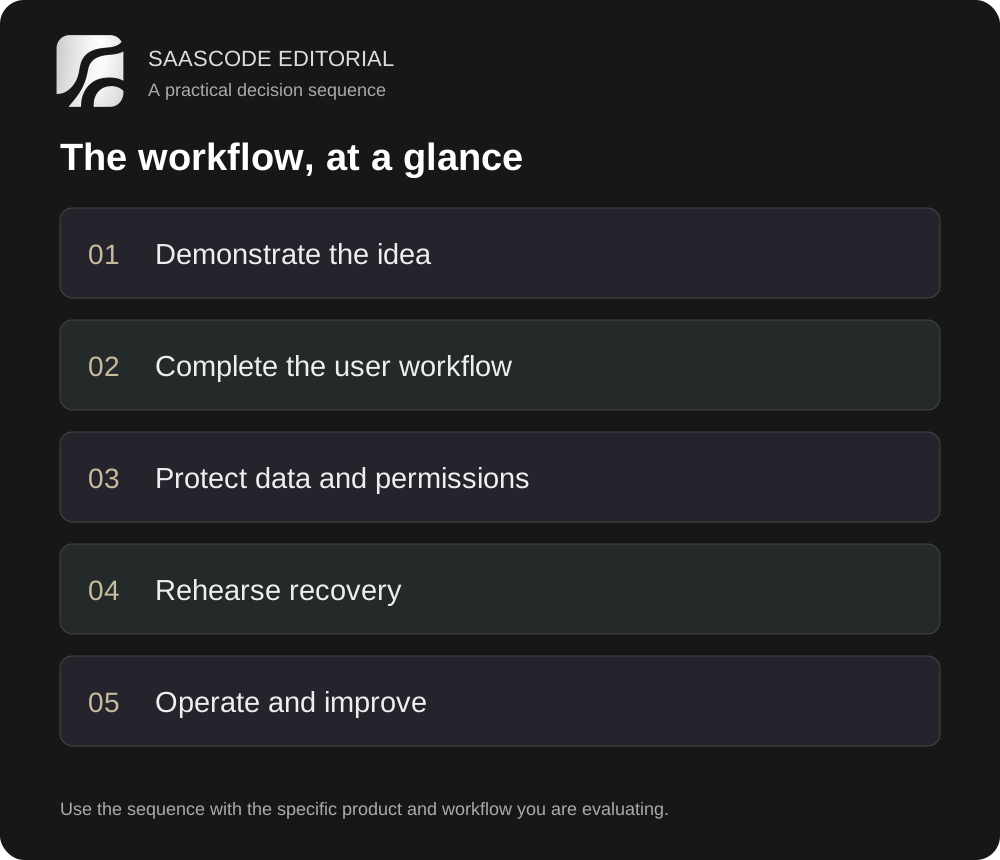
Choose one workflow you intend to sell and rehearse it with representative inputs. Record the missing behavior, configuration and ownership. Estimate the remaining work before calling the application ready for your launch.
Use the source-code launch guide to turn those gaps into a release plan. The goal is an application whose operating requirements you understand, whether its first draft came from a model, a developer or an existing product.
Editorial collaborations
Something useful to add?
Bring a documented case, an expert perspective or a better source to the SaaSCode blog.
Editorial collaborations