
On this page
Cross-promote two SaaS products when the second one helps a customer with a need they have now, and place the recommendation where that need is already visible. Explain the next step, keep the original task available, and let the customer decline. Owning both products is a reason to investigate the connection; it is not a reason to show every customer the same offer.
For an operator running several SaaS businesses, a useful recommendation can introduce a service to someone who already understands the surrounding problem. The hard part is choosing the audience, moment and promise. A course learner looking for a job and an employer looking to hire may use the same job board, but they should not receive the same invitation.
Below are three proposed recommendations using product categories available in SaaSCode's catalog, followed by a small fictional measurement example. The products are real; the placements, wording and results are editorial examples, not shipped cross-product features or a customer case.
Give the recommendation a specific job
Start with a sentence that describes the customer's next task: “After learning this skill, I want to find relevant roles,” or “We have accepted the request; now someone needs to own the work.” Then check whether the second product actually serves that task for this person.
Our complementary-product guide explains how to choose the relationship. This article assumes you have a plausible pair and focuses on how to introduce one to users of the other.
Three facts should be visible in a recommendation: why it appears here, what the destination helps with, and what changes when the person follows it. If the second service needs a separate account, say so before implying a connected experience. If a record will not move automatically, avoid language that suggests it will.
You can start with a public help article or a resource section you already maintain. An in-app placement may require product work. Neither route requires a shared database, an account merge or a combined subscription merely to establish whether the adjacent offer is useful.
Example 1: a learner exploring the next career step
Coursio is presented as a platform for operating branded recorded-course schools. Vacanta is a niche job-board product with candidate and employer workflows. Those roles make a learning-to-employment recommendation worth investigating for a school serving a particular profession.
The audience condition is narrower than “everyone who finished a course.” A person may be learning for their existing job, helping a colleague or studying for personal interest. Completion alone does not establish job-seeking intent.
An appropriate first placement could be a school's optional career-resources page, where the learner has already chosen to explore work opportunities. For a school whose audience and region match the board's current listings, proposed copy might read:
Looking for roles that use these skills? Explore relevant vacancies on our separate job board. Check each employer's requirements before applying. Your course access stays here; a candidate profile on the board is a separate step.
The link could say “Explore current roles in this field.” It should lead to an actually maintained set of relevant listings. If a useful filtered destination does not exist, create and review the resource before advertising it. A general landing page full of unrelated jobs does not fulfill that link's promise.
Keep course materials and completion records easy to reach. Do not put a job-board signup in front of something the learner already earned. Nor should the recommendation imply that a course guarantees employment, qualifies someone for every listing or causes employers to accept an application.
Suppress the suggestion when the learner says they are not looking, has dismissed it, or would arrive at an empty or unsuitable destination. Treat those states as reasons to improve targeting, not as objections to overcome with a louder banner.
Example 2: the same ecosystem, a different buyer
Now imagine a company training staff through a school asks how to reach candidates in that profession. This is an employer need, even if the person also has a learner account.
Vacanta's public product description distinguishes companies publishing vacancies from candidates searching and applying. It also describes moderation before publication. A proposed employer recommendation should therefore introduce the posting process, not send the company through a candidate signup or promise instant publication.
For an employer-resources article, suitable copy could be:
Hiring in this field? Review the job board's employer posting process, audience and requirements. You will create and manage the vacancy in that service; publication follows its review process.
The destination should explain the employer offer and its actual conditions. Verify the current pricing, posting limits and review expectations before putting any of them into the recommendation. This article does not assume a free listing, a particular plan or access to school learner records.
This second example matters because audience overlap is not the same as role overlap. “Our users work in healthcare” is too broad to determine whether someone needs training, a job, a hiring tool or none of those today.
The two businesses can share a relevant editorial resource while keeping accounts, responsibilities and data boundaries clear. Shared ownership does not mean that candidate profiles, learner histories or contact details automatically belong in both applications.
Example 3: after intake, someone must own the work
Formlet covers form creation and response collection. Taskline covers team project work, including tasks and several views of that work. An operator serving agencies could investigate a recommendation from intake guidance to delivery planning.
The trigger is an accepted request without a clear owner or next step. A newly received form submission is weaker evidence: it might be spam, incomplete or outside the service's scope. Do not promote every submission straight into a promise to deliver it.
A contextual resource beside a guide to reviewing requests might say:
Accepted the request? Give the work an owner. If your team does not already have a working task system, see how a separate project workspace could organize the next steps. This recommendation does not copy the response or create a task for you.
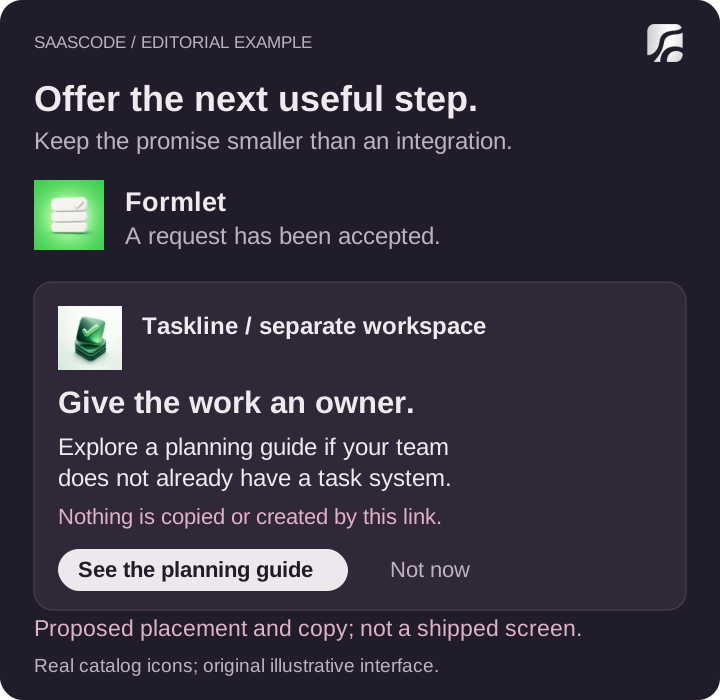
Original editorial mockup, not an existing Formlet or Taskline screen. It shows the recommendation's scope and an optional exit; no integration is demonstrated.
For a team already using an effective task system, skip the offer. A help article about assigning the accepted request in their existing process may be more valuable than asking them to replace it.
If customers repeatedly want automatic transfer, that becomes a separate implementation decision. The guide to connecting two SaaS products covers the additional questions around ownership and reliable handoffs. A link can test interest in the next job without claiming that the connection already exists.
Choose the moment as carefully as the message
A recommendation competes with whatever the person came to do. Prefer a relevant resource page, a natural pause after a successful step or an optional explanation near an unresolved adjacent need. Avoid interrupting a payment problem, an urgent support task or a failed import with another purchase invitation.
For the first version, choose one placement and make dismissal meaningful. A reasonable starting policy is to stop showing that offer after the person declines it, and revisit it only after a new relevant action or an explicit request. That is a proposed product choice, not a universal frequency rule.
Keep the destination consistent with the wording. If the button offers a guide, open a guide. If it offers a demo, make the demo and any access requirements clear. If the service belongs to the same operator, say so plainly rather than presenting the recommendation as an independent review.
These examples concern public pages and optional in-product recommendations. An email campaign is a separate channel decision, with its own recipient permissions, preferences and applicable rules to review. A shared company name is not a plan for moving mailing lists between services.
Measure useful progress and protect the original task
Clicks tell you whether people followed the invitation. They do not show that the destination was useful, that a customer paid or that the recommendation caused an additional sale.
Define a destination action connected to the offer. In the career example, saving a relevant vacancy could be an early signal of interest. It is still several steps away from an application or a job. In the task example, assigning a real accepted request might be more informative than opening an empty board. Choose a signal you can actually observe under the measurement setup you operate.
Here is a fictional illustration using 100 eligible learners. Fifty are assigned to see an optional career recommendation and fifty to a holdout group without that placement. Both groups have the same eligibility rule and a fourteen-day observation window starting at eligibility. The holdout can still discover the job board through ordinary routes.
| Within the same fourteen-day window | Recommendation group | Holdout group |
|---|---|---|
| Eligible learners | 50 | 50 |
| Clicked the recommendation | 16 | Not shown |
| Saved a relevant vacancy | 6 of 50, or 12% | 4 of 50, or 8% |
| Retrieved their existing course completion record | 46 of 50, or 92% | 48 of 50, or 96% |
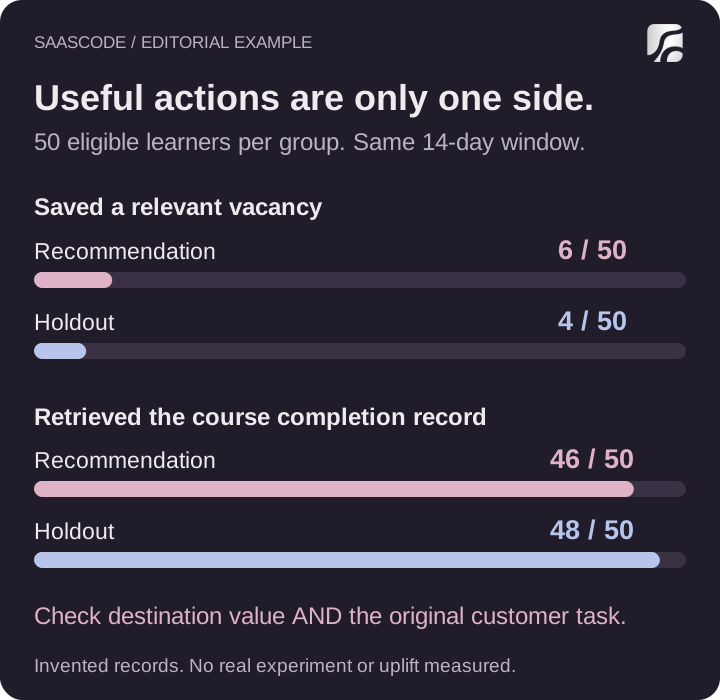
Original diagram calculated from invented records. The observed differences illustrate questions to investigate; they are not measured uplift or evidence about these products.
The destination-action difference is four percentage points: 12% minus 8%. The primary-task difference goes the other way, also by four points: 92% versus 96%. That is a reason to investigate whether the placement distracts from retrieving the completion record, alongside other possible explanations.
Even in this invented example, the six destination actions are not six proven incremental outcomes. Four learners in the holdout reached the same action without the recommendation. And the small difference between groups does not, by itself, establish a reliable causal effect. Our arithmetic check used fabricated records; no real experiment or statistical significance test was performed.
For an actual trial, decide eligibility, assignment, observation windows and success criteria before launch. Keep people in a stable group and account for other campaigns that reach them. Report how many have completed the window; someone who has had one day should not be compared as though they had fourteen.
Use the least information needed to answer the question. Do not put email addresses or private customer details into referral URLs. If you cannot observe the destination action reliably, report clicks as clicks and the later outcome as unknown. Avoid filling a measurement gap with an assumed conversion rate.
Let interlinking explain the relationship
Public articles can introduce the second product while helping readers understand the surrounding decision. A guide about the work after a client request can link to a task-management explanation. A career resource can link to a relevant board and explain who it serves. Each page should still be useful on its own.
Google's link best practices recommend descriptive, contextual anchor text and crawlable links. Use wording that tells the reader what comes next, rather than a chain of generic “learn more” links or repeated keyword anchors.
This is not a reason to make every product site link to every other one. Google's spam policies identify excessive link exchanges and partner pages created just for cross-linking as link-spam examples. The useful relationship belongs to the customer's work; the existence of two domains is not an SEO result.
A contextual referral also makes a smaller commercial promise than a bundle. If customers later want one purchase and coordinated support, use the bundle-versus-separate-offers guide to evaluate that step. Do not let promotional wording create a combined service you have not agreed to operate.
Start with one recommendation you can keep accurate
Choose one audience, one visible need and one destination that is ready to help. Write the reason for showing the recommendation and the reasons for suppressing it. Keep the current task intact, state the relationship between the services, and judge the trial by useful progress as well as attention.
SaaSCode's finished products can provide the software foundation for complementary businesses you operate and adapt. The recommendation layer remains a deliberate part of that business: current listings, relevant copy, honest handoffs and someone responsible for keeping them accurate.
For the examples here, the smallest useful next step is an optional career resource, an employer-specific posting explanation or a guide to assigning accepted work. Each has a clear recipient and a limited promise. Expand the relationship only when customer behavior and operating capacity justify more.
Product descriptions and primary search guidance checked October 8, 2026. SaaSCode publishes this article and offers the named products. All recommendation copy, placements and numerical outcomes above are illustrative.
Editorial collaborations
Something useful to add?
Bring a documented case, an expert perspective or a better source to the SaaSCode blog.
Editorial collaborations