
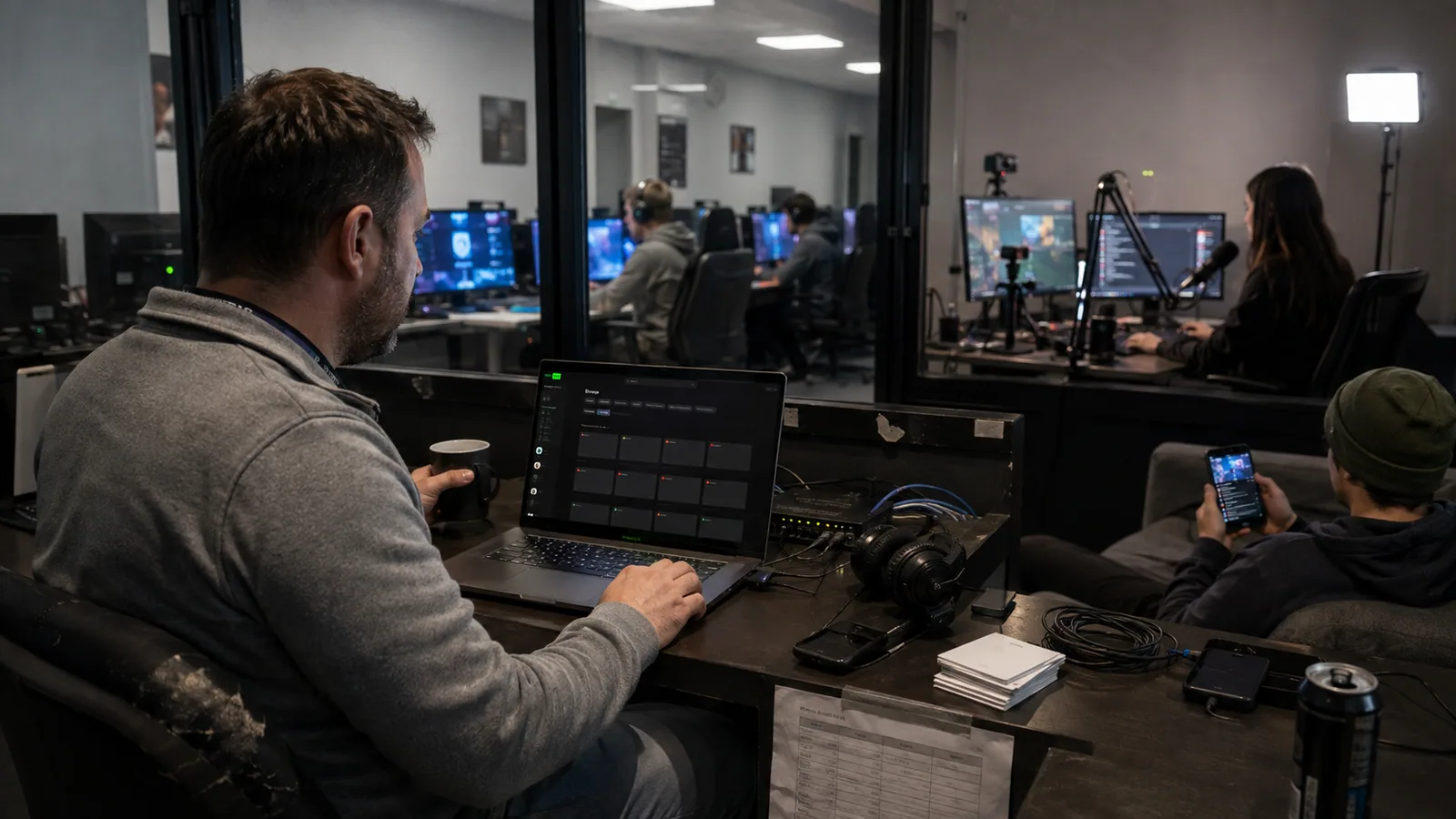
A live stream leaves two assets behind. One is the recording viewers can replay. The other is the relationship that formed around the channel: the conversation, the repeated participation, and the reasons to return. Many streaming products preserve the first while scattering the second across unrelated services.
Thick joins those two assets and puts the economic meter inside the operator's business. Its public proposition is a live-streaming platform sold as source, with a media server the buyer runs and no Thick fee attached to each viewer-minute or subscriber. That decision does not remove the economics of video. It changes who owns them.
The resulting product links the live moment to the parts that remain after a broadcast: replays, channel feeds, comments, direct messages, subscriptions, tipping, and gamification. The build is therefore not only about moving video. It is about turning a stream into an operated community.
The starting point was the ownership boundary
Streaming products are often described from the viewer inward. The player has to start quickly, the chat has to feel current, and the replay has to remain useful. Those requirements matter, but they do not explain who controls the service. The same viewer experience can sit on top of a rented platform, a usage-priced API, a self-hosted media engine, or an application codebase owned by its operator.
Thick takes the last route. The buyer receives the platform as source, applies a brand, and runs the media server. This makes infrastructure an explicit part of the product contract rather than an invisible service hidden behind a plan. The operator gains control over the application and assumes the work that a managed vendor would otherwise perform.
That boundary is more durable than a feature checklist. Chat, replay, and tipping can appear in several products. The harder question is what remains under the operator's control when the audience grows, a cost model changes, or the community needs a rule the original vendor never anticipated. Thick's answer is the codebase and the media operation, together.
Reading a market with different kinds of product
The live-video market groups unlike purchases under similar language. Uscreen sells a managed membership platform. Its current offers combine hosted video, native livestreaming, monetization, and plan-dependent paths to apps, migration, community, and support. The customer configures and operates a business on Uscreen while Uscreen continues to run the underlying service.
Mux sits at another layer. It provides video input, storage, delivery, player, analytics, and related APIs on a usage-priced infrastructure model. A team can build a distinctive application on top of it, but the API does not arrive as the finished creator-community product. The team still supplies identity, channels, relationships, moderation, monetization, and the rest of the operating surface.
Self-hosted engines change the boundary again. Ant Media Server focuses on real-time protocols, SDKs, transcoding, and scaling. Owncast provides a single-user open-source live stream with a web interface and chat. Both give an operator more infrastructure control than a hosted membership suite, yet neither has the same product shape as Thick.
These are not weaker and stronger versions of one thing. They are different contracts. A managed suite is useful when operational transfer is the point. A video API is useful when the application will be built around a managed media primitive. A streaming engine is useful when protocol and delivery control come first. Thick is the application-and-ownership route: the live experience, community, and platform economy arrive in the product while the media server remains the buyer's responsibility.
Five decisions give the product its shape
The server belongs to the operator
The first decision is literal. Thick's buyer runs the media server. That places capacity, delivery architecture, and operational response closer to the business than they would be in a fully managed membership platform. It also prevents the product vendor from charging a platform tax on every viewer-minute.
The decision should not be confused with free delivery. Compute, bandwidth, storage, observability, security, and maintenance still exist. Ownership turns them into selectable operating inputs. It does not make them disappear.
The live session is part of a consumer product
The second decision is to wrap streaming in a consumer-facing experience. Thick's documented surface includes live video, chat, replays, and moderation. That set joins the synchronous event to two practical continuations: the recording can remain available, and participation can be governed inside the same platform.
This is the point at which a media server becomes insufficient on its own. A server can carry the broadcast. The application has to explain where the stream lives, how people respond, what happens after it ends, and how an operator handles conduct.
The channel persists after the broadcast
The third decision is to keep community attached to channels. Each channel has a feed and comments, while one-to-one direct messages allow relationships to continue outside a public thread. The product description does not establish recommendation algorithms, discovery ranking, or a universal social feed. It describes a narrower and more legible structure: community is organized around the channel.
That continuity changes the role of replay. A replay is not only archived video. It sits inside the same channel context as the live event and the surrounding conversation. The value of the channel can therefore accumulate between broadcasts rather than resetting each time the encoder stops.
One currency crosses several participation modes
The fourth decision is to use wave-coin across channel subscriptions, tipping, and gamification. A common platform unit lets recurring support, direct appreciation, and participation mechanics share one vocabulary. The public product facts establish those uses and no more.
They do not establish settlement, cash-out, processing, custody, or compliance mechanics. Those questions remain important precisely because an internal currency can touch both engagement and money. The responsible description is that wave-coin powers the three documented modes, not that every financial workflow around them is already defined.
The platform tax is separated from infrastructure cost
The fifth decision is commercial. Thick does not add a fee per viewer-minute or per subscriber. That is different from claiming the service has no marginal cost. Video infrastructure usually scales with some combination of duration, storage, delivery, compute, and operational coverage.
Separating the two makes the cost model inspectable. The operator can distinguish what the code acquisition costs, what the chosen infrastructure costs, and what the business charges its own users. A managed vendor combines more of those layers into its subscription and usage terms. Thick exposes the boundary instead.
Ownership moves the hard work; it does not abolish it
The strongest argument against this model is operational, not rhetorical. Managed platforms have teams, established delivery systems, support processes, migration paths, device apps, and vendor roadmaps. A source-owned application with a buyer-run media server asks the operator to provide or commission the equivalent operational competence for the scope being launched.
Live video makes that responsibility visible. A delayed page can be retried; a failed live event cannot be replayed as though it happened correctly. Capacity planning, monitoring, incident response, abuse handling, and maintenance become part of the product business. Thick's public record does not promise a CDN, latency target, protocol set, concurrency ceiling, uptime commitment, or support organization, so none should be assumed from the word “platform.”
The community layer introduces a second kind of responsibility. Chat, comments, feeds, and direct messages create places where conduct has to be governed. Thick includes moderation, but the public record does not describe the policy, staffing model, automation, appeals process, or jurisdictional rules an operator will need. Product capability and operating policy meet here; neither substitutes for the other.
Wave-coin adds a third boundary. It can organize subscriptions, tips, and gamification, but any real launch must decide how that unit relates to payment, accounting, user expectations, fraud, and applicable law. The product fact is useful. The missing operational decisions are equally real.
What the product resolves
Thick resolves a specific combination that the market often splits across layers. It supplies a rebrandable consumer-facing live-streaming experience, the chat and moderation around the event, replays after it, a per-channel community with comments and direct messages, and a platform currency that connects subscriptions, tipping, and gamification.
It also makes the ownership decision explicit. The buyer owns the platform and runs the media server. Thick's own commercial model does not grow a viewer-minute or subscriber tax alongside the audience. The operator accepts infrastructure and operational responsibility in return for that control.
The product does not need to be described as a copy of a famous streaming service to make the category legible. Its position is clearer when the transaction is stated directly: this is source for operating a branded streaming community, not an account inside somebody else's platform and not a bare video API waiting for the rest of the product to be invented.
This story documents the product shape and the ownership trade-off rather than announcing a release. Thick is listed at $499 and can be bought at https://saascode.ai/products/thick.