
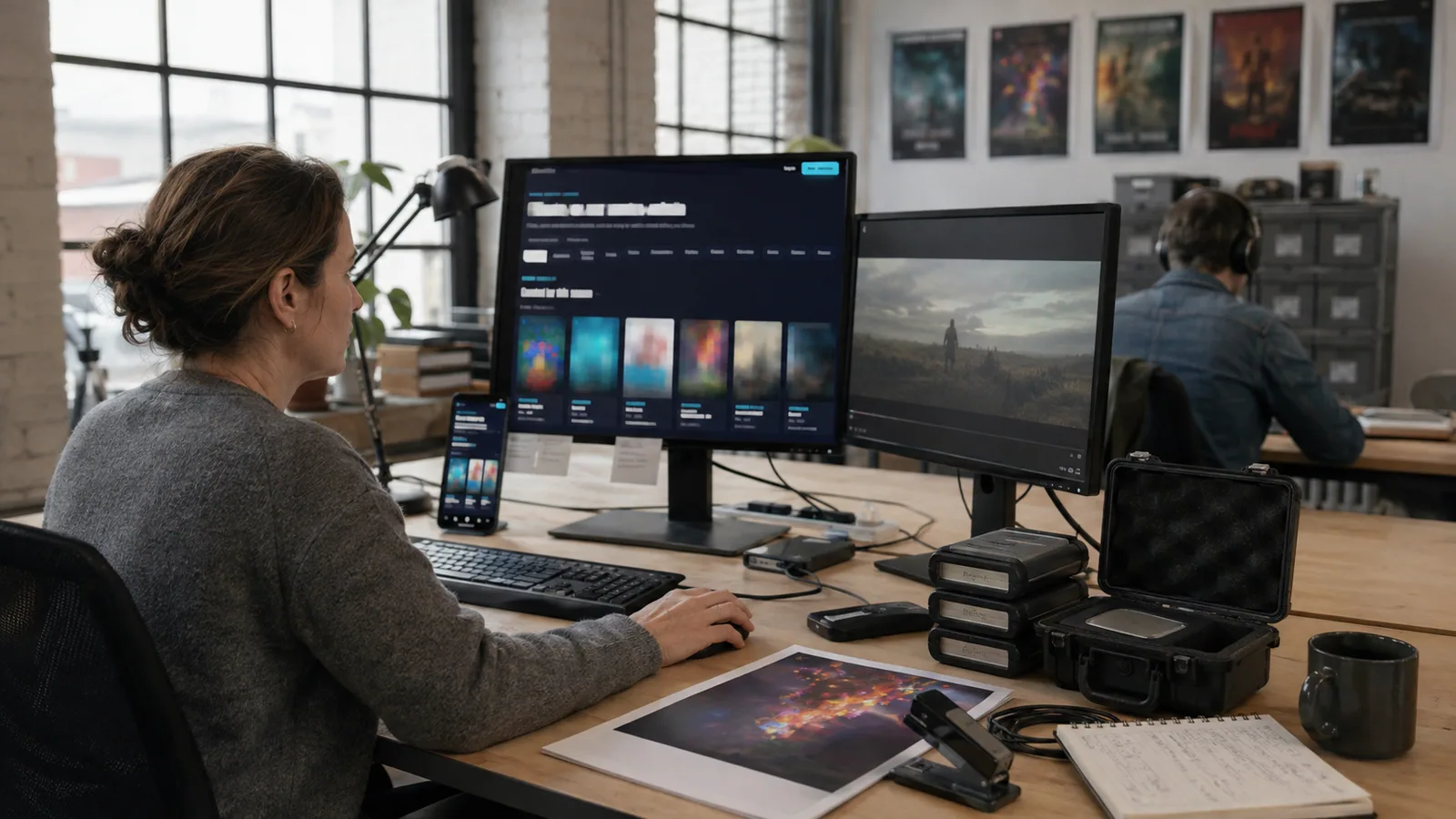
The most revealing word in a streaming product is not video. It is access. A viewer presses the same Play button whether access came from a recurring subscription, a permanent title purchase, or a rental. The interface can make those relationships look identical. The business behind them cannot.
Kineflix took shape around that mismatch. It is a responsive, single-owner OTT/SVOD web service for a branded library of standalone titles and episodic series. Its commercial model accommodates configurable subscriptions alongside individual purchase and rental rights. Its operating surface joins catalog, media, subscribers, and revenue in one back office. That combination says more about the product than a screenshot of a streaming homepage could.
One action, three commercial truths
A subscription is a continuing relationship. Access depends on the subscription offer and the subscriber's current relationship with it. A title purchase is different: the commercial object is a specific work. A rental is different again because the right is bounded rather than ongoing. Each ends at playback, but each begins with a different promise.
That difference is easy to erase when a product is designed from the viewer surface inward. A row of posters, a title page, and a player can imply that the hard work has been solved. In reality, those surfaces only become a service when the operator can explain why a particular viewer has a particular right to a particular title.
Kineflix's product description keeps the three relationships visible. It does not reduce the business to a generic “paid content” label. Configurable subscriptions sit beside individual purchases and rentals, allowing the operator's offer to reflect the way a library is actually sold. The useful design constraint is not how many payment buttons appear. It is whether the system can preserve the commercial meaning after the transaction is over.
A catalog is not a folder of files
Standalone titles and episodic series are different editorial objects. A film, lecture, performance, or documentary may stand alone. A series creates continuity: episodes belong to a larger work, and the service has to present that relationship clearly enough for viewers to understand it.
The Kineflix catalog supports both shapes. That is a modest sentence with substantial consequences. It means the library is not described only as uploaded media. Catalog and media remain separate operating concerns inside the back office. One describes what the audience is offered; the other concerns the material attached to that offer.
Keeping those concepts distinct prevents the player from becoming the data model. A media file may be replaced without changing what the title means to the audience. A series may grow without becoming an unrelated pile of episodes. A commercial right can be attached to the published object rather than to an implementation detail that viewers should never have to understand.
Kineflix does not claim scheduling, editorial workflow, localization, recommendations, or catalog import. Those are common category features, but common is not the same as present. The build story remains stronger when it stops at the product boundary it can support.
Familiarity without borrowed ownership
Kineflix's subscriber surface follows familiar streaming conventions. That choice reduces the amount of explanation a viewing interface needs. People already understand that a poster opens a title, that an episodic work contains a sequence, and that a profile represents a continuing relationship with the service.
Familiarity can also be misleading. A recognizable layout may tempt a product to borrow the identity of the category leader or imply that visual resemblance establishes equivalent operations. Kineflix's description makes a different claim. The conventions belong to the subscriber experience; the rights, profile, and audience data remain Kineflix-owned.
This is the dividing line between a familiar product and an imitation claim. The product can meet viewers where their habits already are without describing itself as another company's codebase, catalog, or service. The interface pattern is a language. The operating system behind it has to belong to the business using it.
The back office is where the service becomes a business
The viewing surface receives most of the visual attention, but the back office carries the operator's daily work. Kineflix brings catalog, media, subscribers, and revenue into that surface. Those four domains form a practical loop.
Catalog determines what is offered. Media connects the offer to something that can be viewed. Subscribers represent the continuing audience relationship. Revenue shows the commercial consequence of those relationships. None of the four is useful in isolation, and none can be replaced by a polished home screen.
This is also why the product is described as single-owner. The system is not presented as a marketplace in which unrelated studios administer independent businesses. One operator publishes the branded library and runs the subscriber business. The constraint clarifies whose catalog, rights, profiles, audience, and revenue the back office is built to manage.
Single-owner does not mean single-user, single-title, or single-revenue model. It identifies the business boundary. The operator may serve an audience through subscriptions, purchases, and rentals, but the service itself has one owner. That is a more useful architectural statement than applying the language of multi-tenancy to every source-code product by default.
Responsive web first is a real boundary
OTT is often used as though it automatically means every phone, television, streaming stick, and living-room operating system. Kineflix is described more narrowly and more clearly: it is a responsive web service. That supports a subscriber experience across web screen sizes without silently promising a native application estate.
The distinction matters because native apps are not merely alternative views. They introduce store accounts, review processes, device capabilities, release channels, purchase rules, and ongoing compatibility work. A product that does not document those surfaces should not acquire them through category shorthand.
The same discipline applies to video infrastructure. The product description does not establish live streaming, encoding, DRM, CDN capacity, or a managed hosting service. The application can still have a coherent purpose without claiming the whole delivery stack. Its stated job is to operate the branded web service, commercial rights, catalog, audience, and back office.
This boundary gives the buyer a more truthful starting point. It also keeps the editorial story about the stated product rather than the generic OTT suite that a reader might imagine.
Source ownership moves the decision, not the responsibility
Kineflix is sold as source, which changes where product decisions can be made. The operator is not confined to a hosted vendor's roadmap or configuration surface. The application can be adapted under the buyer's brand and business.
That control does not make the operating work disappear. Infrastructure, security, maintenance, content rights, support, compliance, and audience development remain the operator's responsibility unless a separate service explicitly covers them. Source ownership turns some vendor constraints into engineering choices; it does not turn a software acquisition into a managed streaming company.
The licence boundary matters too. The buyer acquires the product to customize, deploy, and operate a service. That is different from acquiring source as inventory to redistribute. The business built on the software is the thing being launched.
For an OTT/SVOD operator, this is a particularly consequential distinction. A hosted service can remove a large amount of platform work, while an owned codebase can expose the product layer to change. Neither route is universally correct. Kineflix belongs to the second route, and its value depends on the buyer actually wanting that responsibility.
What the record refuses to turn into a story
Many build narratives become more dramatic by adding incidents, performance numbers, architecture choices, or breakthrough moments. None is documented for Kineflix in the evidence available to this article. Inventing them would make the story more vivid and less true.
The same constraint protects the feature story. There is no verified claim here for native apps, live broadcasting, advertising-supported video, DRM, encoding, recommendation systems, localization, tax logic, provider integrations, concurrency levels, or uptime. They are not smuggled into the article because they sound normal in the category.
What remains is still substantive: a single-owner web service; two catalog shapes; three commercial relationships; a familiar subscriber surface; Kineflix-owned rights, profile, and audience data; and a back office that joins catalog, media, subscribers, and revenue. That is the product's actual design argument.
The product is the relationship behind Play
Kineflix is easiest to understand when the player is treated as the endpoint, not the product. The product is the chain connecting a branded title or series to a subscriber, a commercial right, and an operator who can manage the outcome from the back office.
Subscriptions, purchases, and rentals make that chain more demanding because a single visible action can represent three different agreements. Standalone titles and episodic series make the catalog more demanding because the published objects do not all have the same shape. A familiar subscriber interface makes ownership more important because the surface should feel legible without becoming borrowed identity.
The result is a focused product rather than a claim to contain every layer of modern streaming. Kineflix gives one operator a branded OTT/SVOD web service to run. The work that follows—content, infrastructure, support, maintenance, and audience—is not hidden by the homepage. It is the business the code exists to support.