
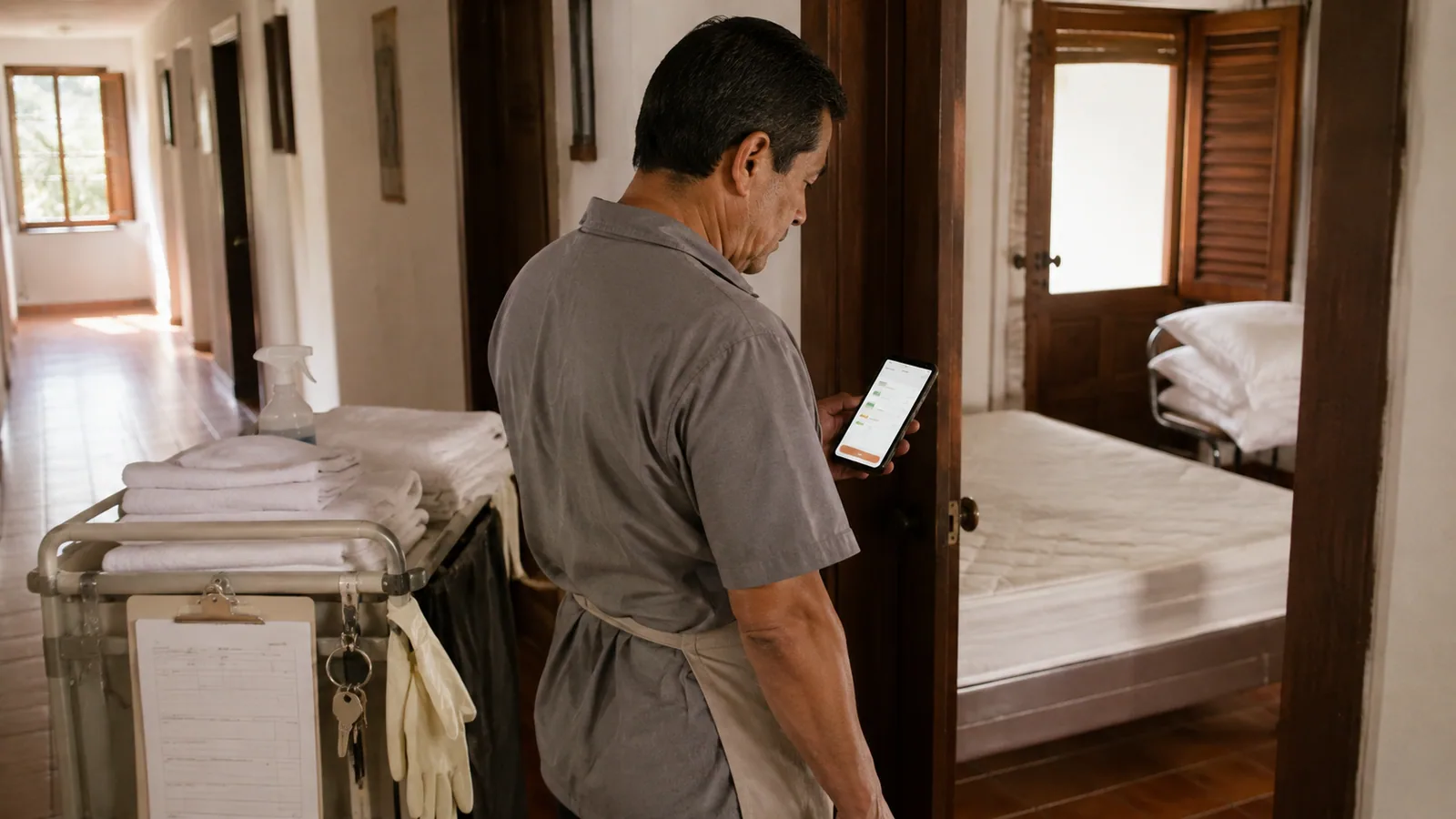
A booking changes meaning several times before a stay is complete. It begins as availability, becomes a reservation, turns into an arrival, accumulates charges in a folio, and ends by creating work for housekeeping. The room is not ready to be sold again merely because the departure time passed. Somebody has to close the operational loop.
That sequence is the useful way to understand Estadia. The product is defined as an operating system for independent accommodations and small property groups, with availability, reservations, rates, arrivals and departures, guest folios, and housekeeping in one workspace. A direct booking engine creates a path into that workspace, while replaceable external-channel synchronization acknowledges that many reservations arrive elsewhere.
The definition is compact, but it contains a strong design argument. Accommodation software is not a collection of unrelated screens. It is a chain of state transitions shared by front-desk work, revenue decisions, guest accounts, and room preparation. Each part needs the context produced by the part before it.
The reservation is not the center
Many hospitality products are first encountered through a booking form or a calendar. Those surfaces are visible because they sit close to the sale. They are not the whole operation. A calendar can show that a room is occupied without explaining whether the guest has arrived, what remains on the folio, or whether the room is ready after departure.
Estadia's scope moves beyond the reservation itself. Arrivals and departures are named alongside reservations. Guest folios are named alongside rates. Housekeeping is named alongside availability. That arrangement treats the stay as a process rather than a row with two dates.
This matters most for independent properties, where the same small team may move between reception, rate updates, guest questions, and room status during a single shift. Fragmented software does not remove those handoffs; it asks people to reconstruct them from memory, messages, and separate tools. A joined operating workspace gives the handoff a place to live.
The product definition does not claim that every hospitality workflow is present. It does something more useful: it identifies the minimum continuous loop that makes the category coherent. Availability without housekeeping can become stale. Reservations without arrivals and departures remain promises without operational status. Rates without folios separate the selling decision from the guest account. The components make sense because they constrain one another.
Direct and external demand meet at one boundary
Independent accommodations rarely control every source of demand. Some guests book directly; others arrive through external channels. A property system therefore has to distinguish the booking source from the operational record of the stay.
Estadia includes a direct booking engine and replaceable external-channel synchronization. Those two phrases describe different responsibilities. The booking engine is a product-owned entry point. Synchronization is a boundary with systems that can change independently.
The word “replaceable” carries most of the discipline. External distribution is not a permanent internal organ of the product. Channels change interfaces, commercial terms, and availability. A maintainable accommodation system needs a boundary that can be exchanged without redefining reservations, folios, or housekeeping every time the outside world moves.
Nothing in the current product record supports naming a particular channel, a connector count, or a synchronization interval. Those details remain outside this article. The durable idea does not depend on them: direct and external demand have to converge on the same internal view of availability and reservations, while the connection to an external source remains substitutable.
That boundary also prevents a common category mistake. A channel manager and a property-management system overlap, but they are not identical. Distribution moves availability and reservations across systems. Property operations continue after that exchange. Estadia's stated scope keeps both concerns visible without collapsing one into the other.
The physical room returns to software
Housekeeping is the point at which software meets the physical state of the property. A departure in a reservation system does not clean a room. It creates a condition that affects whether the room should return to availability and what work must happen first.
Placing housekeeping in the same scope as arrivals and departures closes that gap conceptually. It gives the accommodation record a life after checkout. The operational workspace can represent that a stay ended while the room's next sellable state still depends on work.
The public facts do not describe task assignment, inspections, maintenance, messaging, or mobile workflows, so none is inferred here. Housekeeping remains a named product area, not a bundle of unverified subfeatures. That narrower statement is enough to show why Estadia is not merely a reservation calendar.
Guest folios create a similar bridge. A folio belongs to the stay, but it connects operational events to the financial record the property needs to understand. The current facts establish folios without specifying payment processors, accounting integrations, currencies, taxes, or invoice behavior. Again, the boundary is more informative than an imagined feature list: the guest account is part of the operating loop, while its external financial integrations are not established by the catalog record.
Calm is an information architecture choice
Estadia's description calls the workspace calm. In this context, calm does not need to be treated as a visual adjective. It can be read as a demand on information architecture: show the state that matters for the current operational decision without forcing staff to rebuild the history of the stay.
Availability, reservations, rates, arrivals, departures, folios, and housekeeping are different concepts. Combining them should not mean flattening them into a single overloaded record. It means preserving the relationships among them so that a change in one area arrives with enough context for the next area to act.
For a small property group, that context also has to survive movement between properties. The product definition includes small property groups, but it does not state a property limit, hierarchy, cross-property workflow, or permission model. Those details cannot be supplied from assumption. The defensible observation is only that the target extends beyond one independent accommodation to small groups, and the workspace is meant to hold their operating concerns together.
This restraint is part of the product story. Exact route totals, integration counts, migration numbers, and technical-stack claims would make the article sound precise without making it more truthful. None is necessary to explain the core construction. The product is defined by the continuity of the stay, not by a count of files behind it.
What the product definition commits to
The visible commitment is a joined accommodation loop:
- availability and rates describe what can be sold;
- reservations record what has been committed;
- arrivals and departures move the stay through daily operations;
- guest folios keep the stay's account in view;
- housekeeping connects departure to the next usable room state;
- a direct booking engine creates a product-owned path into the system; and
- replaceable external-channel synchronization lets outside demand enter without becoming the product's permanent center.
Each line is present in the current catalog description. The list does not expand into payments, guest messaging, websites, metasearch, analytics, mobile applications, or named channel connections because the same source does not establish them. A road-to article should not use the absence of a dramatic incident as permission to invent one.
The resulting story is less theatrical than a chronology of bugs and rewrites. It is also more stable. Estadia is organized around the handoffs that make an accommodation stay operationally complete. The booking is important, but the product keeps following the room after the booking form has done its work.
That is the road the product definition makes visible: from an isolated reservation to a continuous stay record; from a channel-specific booking to a replaceable distribution boundary; from checkout as an endpoint to housekeeping as the work that returns inventory. The facts stop before the implementation details, so the article stops there as well.